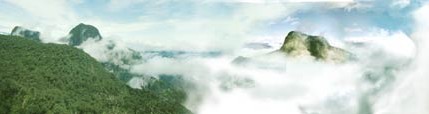
Steep gradients in temperature and rainfall and Earth's highest
biodiversity make this a perfect laboratory for studying species
distributions and climate change. Our current project involves looking
at the factors controlling tree community composition and diversity
along a transect running from the Amazon lowlands to above tree line in
the Andes.
There are as many species of trees in a hectare of tropical rain forest
as there are in all of North America. The Amazon is our lab for asking
why. My students and I have studied the role of life history trade offs
in maintaining diversity in tropical forests, continental-scale
patterns of tree distributions and species diversity, landscape-level
patterns of forest communities, including bamboo forests and swamp
forest, and also the role of animals in the maintenance of diversity in
tropical forests.
The
unmanned aerial systems project is developing new ways to use remotely
piloted and fully autonomous aircraft to address hard-to-answer
questions in forest ecology. Unmanned aircraft enhance our ability to
observe the environment in areas that are too dangerous, too difficult,
or too spatially extensive to observe directly. The lab uses a
multidisciplinary approach that integrates hardware design, software
development, and remote sensing techniques to collect and analyze data.
Current projects include ongoing operation of a multirotor helicopter (DeaconEye) to
collect a variety of types of aerial imagery and atmospheric data,
development of a long-range capable airplane, and development of new,
lower cost aircraft with increased capabilities.
Theories of community structure are usually tested using space as a
proxy for time. Paleoecology allows us to look at time directly. Our
work uses a network of lakes ranging from above tree line in the Andes
down to the lowlands to reconstruct species distributions and plant
communites for the area going back 43,000 years. We also look at the
historical role of humans in tropical ecosystems by analyzing charcoal
and crop pollen. The work also ties together climate change, humans,
and past species distribution with an eye towards predicting how these
ecosystems will change under scenarios of future climate change.
|