Against Fatalism
Introductory Remarks -- What this section appears to me to be about:
不是而然 may mean that the individual propositions are denied, but that the implication is affirmed. See the fourth pair of Venn diagrams below. Or it may mean that the subset is held to be necessarily void when the superset is void, and so there is a concordance between the status of the superset and the status of the subset.
The Mohists deny that people can be fated to do ill or to have bad things happen to them that they are not themselves responsible for, e.g., an early death.
Consider the following cases:
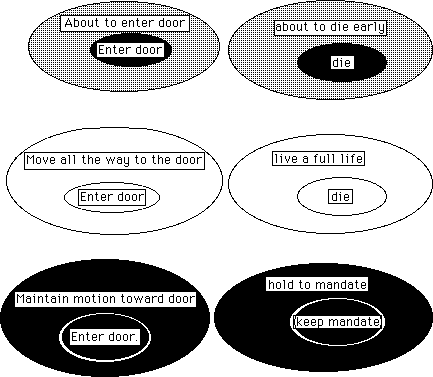
The above diagrams are not quite like traditional Venn diagrams. The intent of these diagrams is to show a final event at the center and one or several courses leading up to that final event. The following diagrams may be more helpful:
(about to enter door ⇒ {enter door}) (about to die early ⇒
{die})
(move all the way to the door ⇒ {enter door}) (live a full life ⇒
{die})
(~maintain motion toward door ⇒ {~enter door}) (~hold to mandate ⇒
{~keep mandate})
In the first pair, "entering the door" and "dying" may or may not occur after some progress is made toward those states. Interpretation of the second pair depends on what is implicit in the phrases "all the way" and "full." In one sense, if you have moved "all the way to the door" there is no alternative to plowing all the way through, and if you have lived out your natural life span then the next natural thing to do is to die. In the third pair, prevention of preparatory action makes the final result become impossible.
On Anti-fatalism
¬Approaching too close to the well → ¬Falling into the well. 不是而然
| A | F | ¬A | ¬F | ¬A → ¬F |
| 1 | 1 | 0 | 0 | 1 |
| 1 | 0 | 0 | 1 | 1 |
| 0 | 1 | 1 | 0 | 0 |
| 0 | 0 | 1 | 1 | 1 |
¬A → ¬F
paradigmatic: A = 0,
F = 0
countercase: A = 0, F = 1
"不是而然" indicates that were
neither antecedent nor consequent
instanced then the implication would be shown true. If it is not
true that you approached too close to the well, and it is not
true that you fell into the well, then one's natural expectations would
have been met and we would say that the implication is a correct
statement about how to conduct oneself in the world. What would
make people doubt the wisdom of that same statement? If you did not
approach too close to the well yet you still fell into the well.
If you did approach too close to the well and you did fall in,
that would be expected. If you did approach too close to the well and
still did not fall in, that has nothing to do with the validity of the
original guarantee that you would not fall in if you stayed away from
the well. You were lucky this time, but it is still true that it is
better not to get too close.
夫且讀書,非讀書也。好讀書,好書也。
Being about to read a book is not to read a
book. Liking to read a book is
liking a book.
且鬥雞,非鬥雞也。好鬥雞,好雞也。
Being about to conduct a cock fight is not conducting a cock
fight. Liking cock fights is liking cocks.
且入井,非入井也。
Being about to fall into a well is not falling into a well.
止且入井,止入井也。
Being stopped from being about to fall into a well is to be prevented from falling into a
well.
且出門,非出門也。
Being about to go out the door is not going out the door.
止且出門,止出門也。
Being stopped from preparing to exit,
however, is
being stopped from exiting.
世相與共是之。
Everyone in the world affirms the preceding
propositions.
若若是,且夭,非夭也。
If the former propositions are correct, then it follows that an
"early death" is
not [really an] early death,
壽,夭也。
and death at a "ripe old age" [can] be an
early death.
有命,非命也。
To have been given a
long [potential] life-span does not mean that you are fated
to live a long life.
[The explanation follows in the next line.]
非執有命,非命也。
If you do not maintain that mandate for a long life-span
(if you don't take
care of yourself in all ways), then you will in effect negate
your mandated long
life-span.
無難矣,此與彼同類。
There is no problem with this doctrine. The
latter group of propositions are
similar to the preceding group.
世有彼而不自非也。
The people of the world
accept those cases and
do not condemn themselves/ hold themselves to be in
self-contradiction.
墨者有此而罪非之。
The
Mohists hold the latter propositions, and are bitterly
opposed by others on that account.
無也故焉,所謂內膠外閉<>而不解也。
There is no
other reason than that [the common people] are stuck on the
inside and locked up
on the outside and so can't get themselves freed up.
此乃不是而然者也
The latter are cases
which [the general population] makes denials but where
things really are that
way.
• The argument appears to be that it is contradictory to hold the first group of several propositions and yet deny the second group of propositions. Here is a paraphrase:
In general, people see that preparation precedes putting something into operation. If they are right, then there is no such thing as "early death," i.e., a death without adequate preparation. Or, to put it in another way, a so-called "early death" occurs only if one does whatever it takes to bring about such a result. If you were supposed to live to 80, but you were careless about your own health and safety and got killed at the age of 40, then that would not be an "early death." Instead, it would be a death that occurred after you had done enough to earn that result.
If, on the other hand, someone lives to eighty, but a brick falls off of the top of a high building and kills that individual, that is a case of "early death" because the individual still had the potential to live many more years.If there can be an "out of season" death, then events can occur without any organic run-up to that final event, and it is certainly true that many kinds of sudden accidents can be deadly.
Preparation for reading a book is not tantamount to reading that book. Anything might change your plans. Planning out a cock fight and having everything in readiness is not tantamount to having a cock fight. What if the police show up and arrest everyone? Getting ready to leave is not tantamount to leaving. The door may be locked. On the other hand, if you do not do the things necessary to leave (or to get an M.D., for instance), there is no way that you can achieve your goal. Everyone can see that the steps leading up to something do not force the next step in the process to occur, and they can also see that without taking necessary steps to achieve some goal the goal cannot be achieved. (One point must be hedged, however. In some cases there is a second course of action, outside of your own control, that can deliver the result that you had begun working for. You might have planned to leave through the door, but before that could happen a tornado might have sucked you out a window.) The general point stands, however, that the tail-end of a process never occurs without the beginning end of the process being initiated and the whole series of events being carried through. The Mohists say that people, generally speaking, all understand this idea of a necessary sequential process toward a goal that can get cut short by outside events.
Perhaps it is in order to comfort themselves or to escape blame for their own shortcomings that ordinary people speak of someone suffering an "early death" when in fact the same kind of necessary sequential process led naturally to that result. Or they may believe that, like all their grandparents and parents, they have been granted a long natural life span. They may even continue to believe this comforting thought, while fueling themselves on brandy and cigars, up to the age of eighty. At that point the natural sequence of events, including their smoking and drinking, may give them a sudden death. But their natural life span may have been one hundred or more. The fact that they were born with a certain kind of natural constitution, a certain kind of "mandate" for a certain lifespan, does not mean that they are sure to attain it.
The Mohists believe that whether people are aware of the natural course of events that lead to death in this case or that case, termination of a life never occurs without a natural sequence of events leading up to it. Part of the natural sequence of events lies in what we would call innate constitution, and part of that natural sequence of events lies in the environment in which the individual lives his or her life.