Introductory Remarks -- What this section appears to me to be about:
On the Irrelevance of Differentiae to Mohists
The question examined is this sections is how to correctly evaluate an implication, X → Y, in the real world—even if ordinary people have preconceptions that suggest another conclusion.
¬(being a Bandit → being Human) (This statement in formal language means: "It is not the case that: 'If one is a Bandit, then one is a human being.'" This negation expresses the view of the non-Mohist majority.
是而不然 (I think this means something like "the antecedent and consequent are both true, but the compound proposition (involving logical connectives) does not express the way things really are. Remember Abraham Lincolns riddle: "If you count a tail as a leg, how many legs does a cow have?" Lincoln's answer was, "Four, because calling something a leg doesnt make it a leg." I infer that many people in the society of Mo Zi's time wanted a moral justification for executing people. They claimed that it was acceptable to execute bandits because they were not really people. They argued, in effect, "It is not the case that if one is a bandit one is a human being.")
¬(B → H) ("B" stands for "One is a bandit," and "H" stands for "One is a human being.")
The proposition under study here claims that it is not true that being a bandit implies being a human being. Common opinion has it wrong. The truth is that to kill a human being necessarily implies killing a bandit. So here is a case of confusing X → Y with Y → X.
paradigmatic case: B = 1, H = 0
contrary case: B = 1, H = 1
When someone is a bandit and not a human being, we see that
this
logical expression would evaluate as true. That belief is what the
general public seems to have accepted as true.
(B = 1 and H = 0, so ¬(1 → 0), and then ¬(0),
so 1)
Truth table for the negation of an implication:
| B | H | B→H | ¬(B→H) |
| 1 | 1 | 1 | 0 |
| 1 | 0 | 0 | 1 |
| 0 | 1 | 1 | 0 |
| 0 | 0 | 1 | 0 |
"是而不然 " indicates that were the antecedents and consequents both instanced then the implication would be shown false. Formal logic shows that the Mohists are right, and that the common opinion is wrong. Supposing that John is a bandit, then it is still true that John is a human being. So executing John would be killing a human being.
Examples: It is not the case that if Ma
Barker loves her son she therefore may be
known to love human beings in general. (This "bù rán" or
denial of validity is correct because the part about her loving all
human beings is false. So saying that since she loves her son she loves
all people is wrong, so it is "rán" or correct to say that the
implication is invalid.)
It is not the case that if
a parrot can safely eat crackers then it can safely consume all grain
products. (Grain products include things like 200 proof grain alcohol.)
獲之親,人也,獲事其親,非事人也。 [This implication is invalid.]
The parents of a bondservant are
people. For a bondservant to serve his parents is not for him to serve
people.
• Commentary: Here the issue for the majority
group of early Chinese thinkers may have been that
the idea of
"serving" in "serving parents" is not of the same meaning as
the
"serving" in "serving people." It is a different relationship. If "to
serve" does have the same meaning in both cases, then it is necessary
to observe that the statement should be qualified to speak of not
serving other people, or to speak of not serving all people. The
Mohists will object that the parents who are served did not cease to be
human beings when they became parents. They just joined a different
subset of human beings. Saying that bondservants serve human beings
does not mean that they serve all human beings, nor does it necessarily
mean that they treat all people whom they serve in the same way.
其弟,美人也,愛弟,非愛美人也。
[This implication is invalid.]
A person's younger brother is a beautiful
person. For that person to love
his/her younger brother is not for him/her to
love a beautiful person.
車,木也,乘車,非乘木也。
[This implication is invalid.]
A wagon is [a] wood[en artifact].
To ride a wagon
is not to ride wood.
• Commentary: It would be fair to say that
someone's
riding a wooden artifact does not amount to saying that he or she rides
all wooden things, but all that is involved here is restricting the range of wooden things that the rider is said to employ.
船,木也,<人>[入]船,非<人>[入]木也。 [This implication is invalid.]
A boat is [a] wood[en artifact]. To enter a boat is
not to enter wood.
盜人,人也,多盜,非多人也。無盜,非無人也。[This implication is invalid.]
A bandit is a human being. An excess number of bandits
is not an excess number
of human beings. To not have any bandits is not to be
without people.
Commentary: All this set of statements
really
establishes is that for some purposes bandits are being counted
separately from other kinds of people and given a quota.
奚以明之?
How are we to get clear on this?
惡多盜,非惡多人也。
To loathe there being
lots of bandits is not to loathe there being lots of human
beings.
欲無盜,欲無人也。
To
desire that there not be any bandits is not to desire that there not be
any
human beings.
世相與共是之。
Everybody in the world would affirm these
propositions.
[However,]
若若是,則雖盜人人也,愛盜人非愛人也,
If those propositions are the case, then although [we know
that] a bandit is a
human being, loving a bandit is not loving a human being,
不愛盜人非不愛人也,
Not loving a bandit is
not to fail to love a human being,
殺盜人非殺人也,
and killing a bandit would
not be killing a human
being.
[However, we have already seen above that loving a bondservant is to love a human being, and loving a slave is to love a human being. So what is going on?]
無難矣。
There is no difficulty in this
matter:
此與彼同類,世有彼而不自非也,
The former set of propositions (i.e., the propositions in the previous section) and the latter set of propositions
are of the
same general form. The people of the world accept the lattrr
cases
and do not
condemn themselves or hold themselves to be in
self-contradiction.
墨者有此而非之,
The
Mohists hold
the latter propositions, and are opposed.
無<也> [他]
故焉,
There is no other
reason for it:
所謂內膠外閉與?
Is not this just a case of
[the others being] what is called "being stuck solid on the inside and
being
locked closed
on the outside,"
心毋空乎內,膠而不解也。
"There
is no space left in their hearts; they are stuck and cannot get loose."
此乃是而不然也。
These are
all
[propositions] that are affirmed but which are [actually] not the way
things really
are.
• Commentary: When both the constituent statements about the real world are found to be true, combining the statements according to the logical operators gives a statement that is in fact not true. In a situation wherein "X is a bandit" is true, and the statement "X is a human being" is also true, then it will be true to say, "If X is a bandit, then X is a human being." But the people who support the accepted "wisdom of the world" have said: "It is not the case that if X is a bandit then X is a human being." They want to affirm that being a bandit excludes one from the set of all human beings.
• Nobody is born a bandit. Some individuals take up banditry at a specific time. Do they then cease being human beings at that time?Relationships that the author discusses include:
(1) Bondservants love their parents.
human beings ∋ parents of bondservants
parents of bondservants ∈ human beings
So it is correct to say that bondservants love a subset of human being, that subset being their parents.
bondservants love parents, a subset of human beings
Schematic: Bondservants ⇒ ({parents} human beings)
(2) An elder sibling loves his or her younger brother. Λ That younger brother is a beautiful human being.
the aforesaid younger brother ∈ beautiful people
beautiful people ∋ the aforesaid younger brother
If this discussion were generalized, then it would become somewhat more complicated because the set of younger brothers and overlaps the set of beautiful human beings. Not all beautiful human beings are younger brohers, and not all younger brothers are beautiful human beings.
So it is correct to say that an elder sibling loves a subset
of
beautiful people, that subset containing the younger brother of the
elder sibling.
Schematic: elder sibling ⇒ (younger brother
{beautiful human beings) }
(3) Human beings ride wagons.
wagons ∈ wooden artefacts ∈ wood
wood ∋ wooden artefacts ∋ wagons
So it is correct to say that human beings ride a subset of wooden artefacts called wagons, and that wagons are a subset of things called wood.
The situation is more complicated than the Mohist philosophers have bothered to note because a wagon is also a subset of things that have some kind of provision for seating or standing securely while in motion. Wagons are wooden artefacts that provide a place on which to ride.
Schematic: humans ⇒ ({[wagons] wooden artefacts}wood)
(4) Human beings enter into wooden boats.
wooden boats ∈ wooden artefacts ∈ wood
wood ∋ wooden artefacts ∋ wooden boats
So it is correct to say that human beings get into a subset of wooden artefacts called boats and that wooden artefacts are a subset of things called wood.
The situation is more complicated than the Mohist philosophers have bothered to note because a boat is also a subset of things that have some kind of an inside. Boats are wooden artefacts that enclose a volume of space.
Human beings enter a subset of wooden artefacts called boats, that subset of artefacts itself being an element of a larger set of things called "wood."
Schematic: humans ⇒ ({[boats] wooden artefacts}wood)
(5) Bandits are human beings. An excess number of bandits is not an excess number of human beings: To not have any bandits is not to be without people.
(I am going to treat this second sentence immediately above as meaning that for people to regard the number of bandits as being excessive is not for people to regard the number of people as being excessive. I will regard the third sentence as meaning that people desire to eliminate bandits, and so forth. I will summarize this behavior by saying that normal people detest bandits.)
bandits ∈ human beings
human beings ∋ bandits
(bandits == null set)
!= (humans == null set)
(Saying that there are no bandits is not the same thing as saying that
there are no human beings.)
Normal people detest bandits.
Normal people ⇒ {(bandits)
human beings}
The above schematics show the reality involved in the cases that the Mo Zi talks about.
It is also possible to discuss a situation in which there are
bandits that happen not to be human beings. Perhaps they are
extraterrestrial beings, or perhaps they are raccoons or baboons.
Normal people ⇒ {(bandits)
non-human beings}
Here are the truth tables for a couple of logical expressions that investigate the circumstances under which logical connections of two simple expressions are true. (For instance, let the compound logical expression be: "Miss Y is the President of the United States, and Mr. X is the Vice-President of the United States." Supposing that the circumstances, the real-world state of affairs, demonstrate that Miss Y is the President and Mr. X is the Vice-President, then the compound statement turns out to be true. Supposing that Miss X turns out to be President and some third person turns out to be V.P., then the original compound statement was an incorrect. If a contestant in a quiz show is required to identify both the President and the Vice-President, but only gets the identify of one person right, then the contestant does not win.
B stands for, "All members of some set, B, are bandits."| B | H | ¬(B → H) | B Λ ¬H |
| 1 | 1 | 0 | 0 |
| 1 | 0 | 1 | 1 |
| 0 | 1 | 0 | 0 |
| 0 | 0 | 0 | 0 |
By examining the truth table above we can see that both verbal formulations amount to the same thing. It is impossible to make a true statement that asserts, one way or another, that bandits are not humans.
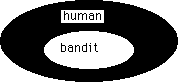
Examining the Venn diagram for this problem we see the same thing given visual form:
The set "bandit" must consist of elements all of which bear the special characteristics of bandits, and they must also bear all of the characteristics of human beings. An analogous set diagram would have "mushrooms" where "bandits" is written, and "toadstools" where "humans" is written. Since it is easier to be dispassionate about fungi, let it be noted at this point that for all mushrooms, to eat a mushroom is to eat a toadstool, but that only some toadstools are the non-poisonous ones we call mushrooms. So while we ordinarily say that humans eat mushrooms, it is nevertheless true that in eating a mushroom one is also eating a kind of toadstool. Similarly, although one may do certain things only to bandits, whatever one does to any bandit is also done to a human being because bandits are also elements of that larger set. When a person becomes a bandit, he or she does not lose the status of human being.
Now let us examine the statements that the "Xiao Qu" chapter of the Mo Zi makes in regard to slaves and other humans:
1. 盜人,人也。 "To be a bandit is to be a human being."
2. 愛盜人非愛人也。 "To love a bandit is not to love a human being."
3. 不愛盜人非不愛人也。"To fail to love a bandit is not to fail to love a human
being."
4. 殺盜人非殺人也。"To kill a bandit is not to kill a human being."
Just as (some) human beings eat mushroom but avoid eating other kinds of toadstools, (some) human beings may kill bandits but avoid killing other kinds of human beings. However, that statement is not the equivalent of what the Mo Zi actually says. The last three statements that are recorded are wrong, and the Mo Zi intends to demonstrate that they are wrong.
The only way that statements 2, 3, and 4 could be correct would be if there were some set of individuals called "bandits" that were not human beings. Perhaps these "bandits" would be raccoons, baboons, or some extraterrestrial creature. But statement 1 says that bandits are human beings.
Statements of this form are called "是而不然." It migbt be paraphrased to say: "A set of statements that, individually, are objectively true can be used to assert a conclusion that is not true.
The paradigmatic case is that in which statement B is true, but statement H is false(i.e., B = 1, H = 0, as in "Zork is a bandit," and, "It is not the case tht Zork is human."). If that circumstance could be found in the world of human experience, then statement 2 would be true. Unless baboons are raiding the homestead (and unless language is being used in a new way), any bandit will fit the description of human being. In short: the paradigmatic case (the case that makes the compound sentence true), B = 1, H = 0, is one that will not be found in the real world."是而不然" indicates that were the
antecedents and consequents both true in this world, then the implication would be
shown false. Since it is the case that :
"All members of some set, B, are bandits," and "all members of
some enclosing set, H, are humans," it is proven that those who
dehumanize bandits are in the wrong. They are the people who would assert sentences 2, 3, and 4 above.
The "Xiao Qu" chapter is generally regarded not to have been written by Mo Zi himself, but to have been written by members of a younger generation who worked in or associated themselves with his school. Mo Zi taught jian aior "universal love," and maintained that it is not good for individual members of any society to discriminate in any way against other members. He would not say, "To love a bandit is not to love a human being." Instead, he would say, "To fail to love a bandit is to fail to love a human being."