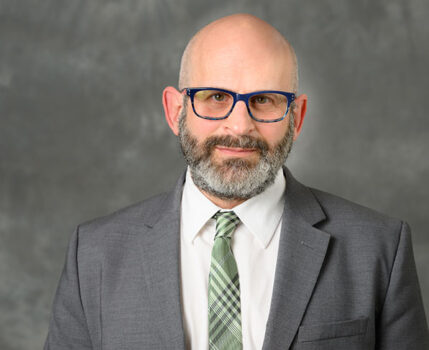
Full of promiseProfessor of Chemistry Mark Welker and his colleagues have high hopes for their cancer prevention research.
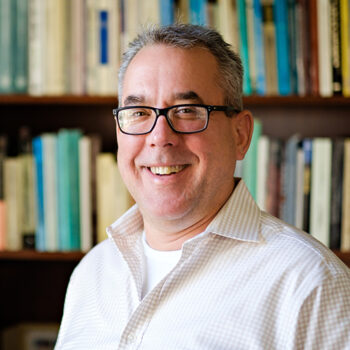
Wake Forest Professor of Chemistry Mark Welker and his student assistants are collaborating with School of Medicine biochemists and cancer biologists Suzy and Frank Torti and Alan Townsend and their teams on a chemo cancer prevention study to develop compounds that would stimulate carcinogen-fighting enzymes in the body. Its one of a number of scientific and public policy initiatives that Welker, an organic chemist with a specialty in the synthesis and application of transition-metal complexes, is participating in that hold promise of health and economic development benefit. The chemo cancer prevention project, which is funded by the National Institutes of Health, grew somewhat serendipitously out of another investigation Welker was conducting in AIDS prevention. In HIV replication, a viral particle first attaches itself to an immune system cell called a CD4 cell. HIV is a retrovirus, which means it contains RNA rather than DNA. The virus can't replicate without a DNA blueprint of itself so it needs to hijack the host cells genetic machinery to multiply. Once the HIV DNA is incorporated into the host cell DNA, transcription continues, but now the host cell is making HIV RNA in addition to its original job. This new HIV RNA is transferred out of the nucleus back into the cytoplasm of the host cell, from where it is transported by a chaperone protein, called a nucleocapsid protein, back out to the cell wall so that a new viral particle can bud and continue the viral infection. The nucleocapsid protein contains zinc in the form of what are called zinc fingers. In their AIDS project, Welker and his associates made organosulfur compounds, which like to bind to zinc. Their hope was that these compounds would enter the zinc finger, bind the zinc, and remove it. The nucleocapsid proteins shape would then change; it could no longer perform its function, and viral replication would shut down. Welker, who oversees three graduate students, four undergraduate research assistants, and a postdoctoral fellow, had been thinking about both biological activitiesHIV replication and chemo cancer preventionfor some time. He discovered that the very same compounds they were developing in the AIDS investigation also showed comparable enzyme-regulating properties for carcinogen detoxification to another compound already available. Welker, the Tortis, and Townsend have patented the compounds for both applicationsAIDS and cancer. We have good ways to make these molecules. They look pretty active, says the chemist, who is in this 17th year at Wake Forest. But there are issues to consider. Its hard to prove that this compound actually prevents cancer; there are a lot of variables involved. And well need long-range toxicity studies. When you take something every day for 50 years, it has to have low toxicity. What I want is a compound that is better than the currently available chemo prevention compound, he goes on. Were close, and the next step will be to write a proposal for a long-range study. In some ways its kind of a racewho will get the best compound first. Its the molecular equivalent of the lottery; you have big odds against you. But I dont worry about it too much. Im primarily interested in the making of the compounds. That instinctive inquisitiveness of the pure researcher takes him in a number of directions. In a different study funded by the National Science Foundation, he is exploring new ways of working with the principle of chirality, or handedness, in molecular structure. Chiralitynon-superimposed mirror images of an objectpermeates the natural world, from screws and vines that twist one way or the other to our feet, hands, and ears. On the molecular level, a compound can be composed of right- and left-handed molecular enantiomers (mirror-image structures) with different physiological and pharmacological effects. One of the most infamous, and tragic, pharmaceutical examples was the drug thalidomide. One of its enantiomers treated morning sickness in pregnant women; the other caused horrible birth defects. Welker is working on new processes to create just one enantiomer of selected target molecules. The bearded, affable Welker, who has directed nine Ph.D. dissertations and five masters theses in his tenure at the University, has secured a solid reputation in the scientific community. He spent 2001-02 as a program officer with the National Science Foundation in Arlington, Va., reviewing and evaluating research grant proposals in organic and macromolecular chemistry. In January, he was sworn in as a member of the N.C. Board of Science and Technology, a 17-member body appointed by the governor to help explore economic development opportunities in biotechnology for the state of North Carolina. |
|
|
|
Wake Forest University Winston-Salem, North Carolina Information: 336.758.5000 | Feedback
|
|