
Tornado Watch - Charlotte
The National Weather Service has issued a tornado watch for the Winston-Salem/Forsyth County area. A tornado watch means tornadoes are possible in and near the watch area. The current NWS watch is in effect 11:00 PM
Please monitor local weather reports for the latest information.
Resources include:
National Weather Service
The University recommends keeping cell phones charged and set to receive calls and text messages.
Updates will be posted here.
In the event of a tornado warning, Wake Forest will use the Wake Alert emergency notification system to communicate with students, faculty, and staff. An announcement would be posted on the Wake Alert web site and the University’s home page at wfu.edu; sent by text, email and voice mail; and posted on the Wake Alert Twitter and Facebook accounts.
Tornado Watch
The National Weather Service has issued a tornado watch for the Winston-Salem/Forsyth County area. A tornado watch means tornadoes are possible in and near the watch area.
Please monitor local weather reports for the latest information.
Resources include:
TV Stations: WXII, WFMY, WGHP or Spectrum News Triad
National Weather Service
The University recommends keeping cell phones charged and set to receive calls and text messages.
Updates will be posted here.
In the event of a tornado warning, Wake Forest will use the Wake Alert emergency notification system to communicate with students, faculty, and staff. An announcement would be posted on the Wake Alert web site and the University’s home page at wfu.edu; sent by text, email and voice mail; and posted on the Wake Alert Twitter and Facebook accounts.
Test of WFU emergency notification system
This is a TEST of the Wake Alert System. The test is being conducted to ensure that the emergency notification system is operating properly. Testing is being carried out by the University Police Department and the Office of Communications and External Relations. No action is required in response to this message. Emergency procedures can be viewed at Wake Alert.
Community Safety Advisory: Fire Department at Carswell Hall
Early this morning, Feb. 19, the Winston-Salem Fire Department responded to a call reporting smoke on the roof of Carswell Hall. A steam cloud from the boiler on the roof was the cause for the concern. There is no fire, and the area is safe.
Community Safety Advisory: University Parkway entrance has been reopened
The University Parkway entrance to campus has been reopened. It had been closed after a charter bus carrying students from Joel Coliseum to campus was hit by a southbound car on University Parkway. All students walked onto campus, and no injuries were reported.
Community Safety Advisory: University Parkway entrance closed after accident
A charter bus carrying students from Joel Coliseum to campus was hit by a southbound car while turning left into the campus entrance off University Parkway. No injuries were reported. The entrance to campus is closed, and Winston-Salem Police and EMS are on the scene.
Tornado Watch
The National Weather Service has issued a tornado watch for the Winston-Salem/Forsyth County area. A tornado watch means tornadoes are possible in and near the watch area.
Please monitor local weather reports for the latest information.
Resources include:
TV Stations: WXII, WFMY, WGHP or Spectrum News Triad
The University recommends keeping cell phones charged and set to receive calls and text messages.
Updates will be posted here.
In the event of a tornado warning, Wake Forest will use the Wake Alert emergency notification system to communicate with students, faculty, and staff. An announcement would be posted on the Wake Alert website and the University’s home page at wfu.edu; sent by text, email and voice mail; and posted on the Wake Alert Twitter and Facebook accounts.
Wake Forest monitoring unstable weather on Tuesday, Jan. 9
The National Weather Service reports a risk of unstable weather on Tuesday, Jan. 9. Heavy rains and high winds are predicted, and conditions may vary during the day and throughout the state. Flooding may occur.
All University operations will take place as scheduled. Weather conditions may be different in Charlotte than in Winston-Salem, and program directors in Charlotte will communicate if conditions require schedule changes. Wake Forest will continue to monitor the weather and will use the Wake Alert emergency notification system to communicate operational changes.
Stay alert and be prepared if traveling. University employees who are scheduled to work from campus and are concerned about traveling, contact your supervisor. If you experience a power outage and cannot work remotely, you may use Administrative Leave time and should notify your supervisor if possible.
The WeatherSTEM stations at the Miller Center (@WakeForestWx) and at Allegacy Stadium (@WFUFootballWx) provide real-time weather data for Wake Forest University and surrounding neighborhoods. WeatherSTEM offers apps for iOS and Android.
Weather forecasts are also available on local TV stations WXII, WGHP, WFMY, Spectrum News 14, and The Weather Channel.
More information on signing up for emergency text alerts and voice messages can be found at Wake Alert here.
– Communications and External Relations
Community Safety Advisory Traffic Alert
The north and southbound lanes of Silas Creek Parkway are closed due to downed power lines. Avoid the Reynolda Road entrance. Plan for delays.
Test of WFU emergency notification system
This is a TEST of the Wake Alert System. The test is being conducted to ensure that the emergency notification system is operating properly. Testing is being carried out by the University Police Department and the Office of Communications and External Relations. No action is required in response to this message. Emergency procedures can be viewed at Wake Alert.
REMINDER: Wake Alert emergency notification system testing Oct. 17 & 19
This is a reminder that tests of the Wake Alert emergency notification system will be conducted this week on Tuesday, Oct. 17 and Thursday, Oct. 19. System tests will occur on both days between 9 a.m. and 9 p.m. The tests are being conducted to ensure that the Wake Alert emergency notification system operates correctly.
If an actual emergency were to occur on the testing dates, the University would use numerous alert methods to inform the campus.
Here is what to expect:
- Test messages will be shared starting at 9 a.m. on Oct. 17. These include notifications via email, text, phone, Wake Safe mobile app, @WakeAlert Twitter and Wake Alert Facebook page. A banner will be posted on the University website. Please update your mobile phone information to receive emergency notifications from Wake Forest by text or phone.
- The emergency notification system will send test messages to every TV that is connected to the campus cable network. This also includes the Stream2 app on any personal device, AppleTV, laptop, phone, etc., if you are logged in and watching at the time.
- The outdoor emergency alert system will be tested.
- No action is required to alert messages during these tests. Testing will be carried out by the University Police Department and the Office of Communications and External Relations.
In addition to the testing procedures outlined above, emergency preparedness for members of the Wake Forest community requires each of us to review the University’s Emergency response, evacuation procedures and notification of immediate threat as posted on InsideWFU.
WFU Emergency Alert Systems testing will be conducted on Oct. 17 & 19
Tests of Wake Forest Emergency Alert Systems will be conducted on Oct. 17 and 19. System tests will occur on both days between 9 a.m. and 9 p.m. The tests are being conducted to ensure that the University's emergency notification systems operate correctly.
If an actual emergency were to occur on the testing dates, the University would use numerous alert methods to inform the campus.
Here is what to expect:
Wake Alert Testing – Test messages will be shared starting at 9 a.m. on Oct. 17. These include notifications via email, text, phone, Wake Safe mobile app, @WakeAlert Twitter and Wake Alert Facebook page. A banner will be posted on the University website. Please update your mobile phone information to receive emergency notifications from Wake Forest by text or phone.
The Emergency Alert System will send test messages to every TV that is connected to the campus cable network. This also includes the Stream2 app on any personal device, AppleTV, laptop, phone, etc., if you are logged in and watching at the time.
The outdoor emergency alert system will also be tested.
No action is required to alert messages during these tests. Testing will be carried out by the University Police Department and the Office of Communications and External Relations.
In addition to the testing procedures outlined above, emergency preparedness for members of the Wake Forest community requires each of us to review the University’s Emergency response, evacuation procedures and notification of immediate threat as posted on InsideWFU.
Community Safety Advisory: Report of indecent exposure at Reynolda Village
Wake Forest University Police received a report of indecent exposure at an off-campus location and is asking the community to be aware of the description of the suspect and his vehicle.
The incident occurred in a parking lot of Reynolda Village (map). No arrest was made. The man was described as a white male with white hair, about 70 years old, weighing 210-230 pounds and between 5-feet-10-inches and 6-feet tall. He was wearing a gray t-shirt and light-colored shorts, and he was driving a white 1999 Dodge Dakota pickup truck with a spare tire visible on the right side of the truck bed.
If you have any information that might be helpful in this investigation, contact the University Police at (336) 758-5911. If you wish to provide information anonymously, do so through “Silent Witness.”
Personal Safety & Crime Resources
Always be aware of your surroundings and watch out for one another. If you feel uneasy or unsafe, go to a safe location and call a friend or the police at 911. University Police offers a safe escort service on campus that is available 24 hours at 336-758-5911.
Wake Safe
- The Wake Safe mobile app is free and makes it easy to engage with the Wake Forest University Police Department. With Wake Safe, you can use your cell phone as a personal security device that allows direct access to police, 911 emergency services, emergency, location sharing, social escape, and a peer-to-peer Friend Walk tool. Wake Alert emergency and safety messages are also shared on Wake Safe. Be sure to activate notifications.
Emergency call boxes
- The University has added and upgraded Blue Light Emergency call boxes (also known as DEACStations) throughout campus. The DEACStations have 360-degree camera views. When the emergency button is pressed, University police are immediately alerted. A map with locations for Blue Light call boxes can be found here.
Beware of fraudulent phone calls to families
Wake Forest University Police has received information regarding a fraud scheme in which individuals claiming to be law enforcement officers or others involved with the criminal justice system are targeting WFU families of student-athletes. The caller tells a parent or family member that their student has been detained and money must be sent using Venmo or a similar app for the student to be released.
If you receive a call, text or email from someone who requests that you send money to resolve an issue, the story can be compelling. Do not send money. Law enforcement agencies will never ask you for money over the phone.
Spoofing is when a caller disguises the number they are calling from so the call appears to be from a legitimate phone number, in many cases, the University Police Department. It is often used to trick people into sharing personal information — sometimes using fear tactics with false stories of loved ones or friends in trouble and in need of money. This FCC website offers information on spoofing and tips on how to avoid such scams.
Be alert to a possible scam if anyone contacts you unsolicited and asks for money or personal information.
If you have questions or concerns about your student’s wellbeing or whether a call you received is legitimate, call the Wake Forest Police non-emergency number at 336-758-5591.
Community Safety Advisory: Police Activity/All Clear
Winston-Salem Police have left the area around Polo Road, Brookwood and University Parkway. Police were responding to reports of a person breaking into vehicles and trespassing on personal property.
If you have any information that might be helpful in this investigation, contact the University Police at (336) 758-5911. If you wish to provide information anonymously, do so through “Silent Witness.”
Personal Safety & Crime Resources
Always be aware of your surroundings and watch out for one another. If you feel uneasy or unsafe, go to a safe location and call a friend or the police at 911. University Police offers a safe escort service on campus that is available 24 hours at 336-758-5911.
Wake Safe
The Wake Safe mobile app is free and makes it easy to engage with the Wake Forest University Police Department. With Wake Safe, you can use your cell phone as a personal security device that allows direct access to police, 911 emergency services, emergency, location sharing, social escape, and a peer-to-peer Friend Walk tool. Wake Alert emergency and safety messages are also shared on Wake Safe. Be sure to activate notifications.
Emergency call boxes
The University has added and upgraded Blue Light Emergency call boxes (also known as DEACStations) throughout campus. The DEACStations have 360-degree camera views. When the emergency button is pressed, University police are immediately alerted. A map with locations for Blue Light call boxes can be found here.
Campus addressing
Addresses have been added to nearly every area of campus, including parking lots, athletic fields, storage areas, and Hearn and Manchester Plazas. The address can be used with GPS navigation apps and will help emergency responders pinpoint precisely where to go on campus in the event of a 911 call. Reynolda Campus maps have been updated to include the new addresses.
Telephone Boxes are located near some building entrances. Pick up the receiver and dial 911 to reach a dispatcher.
Police Activity along Polo Road
Wake Alert/Urgent for Awareness: Wake Alert/Urgent for Awareness: Winston-Salem Police are responding to reports of vehicle break-ins and trespassing near Brookwood and University Pkwy. Canines are on site.
Community Safety Advisory: Vehicle break-ins
In the past week, University police have received a number of reports of vehicle break-ins. Three were in Deacon Place Apartments (on the corner of Long Dr. and University Pkwy.). Three were in the parking lot at the University’s Indoor Tennis Center (499 Deacon Boulevard).
In these incidents, the vehicle's doors were either left unlocked or the windows were broken. Some involved thefts of items that were left in plain view in the passenger areas of the vehicle.
In response to these reports, University Police is increasing patrols in the area.
UPD asks that campus community members make it a habit to lock vehicles and keep valuables out of view.
The University Police Department encourages students, faculty and staff to promptly report suspicious activity they may observe on and off campus. The University Police Department can be reached at 336-758-5911 (emergency) or 336-758-5591 (non-emergency), through the Wake Safe Mobile App or online. The department is located in Alumni Hall. With immediate concerns, all are encouraged to call the emergency number.
A list of Personal Safety & Crime Resources is available on the University Police Department website.
Update: Innovation Quarter (Wake Downtown) now all clear
Wake Alert Emergency: Innovation Quarter (Wake Downtown) is now clear. The Winston-Salem Police Department was responding to an attempted robbery in a parking lot nearby.
Heavy Police Presence on Campus (Wake Downtown)
Wake Alert Emergency: There is police activity in the area of INNOVATION QUARTER (Wake Downtown), please avoid the area until further notice.
Severe Thunderstorm Warning
Wake Alert Emergency: The National Weather Service has issued a severe thunderstorm warning for the Wake Forest University area. Seek shelter.
Community Safety Advisory: Beware of fraudulent phone calls to families
Wake Forest University Police has received information regarding a fraud scheme in which individuals claiming to be law enforcement officers or others involved with the criminal justice system are targeting WFU families. The caller tells a parent or family member that their student has been arrested and bail bond money must be sent using Venmo.
If you receive a call, text or email from someone who requests that you send money to resolve an issue, the story can be compelling. Do not send money. Law enforcement agencies will never ask you for money over the phone.
Spoofing is when a caller disguises the number they are calling from so the call appears to be from a legitimate phone number, in many cases, the University Police Department. It is often used to trick people into sharing personal information — sometimes using fear tactics with false stories of loved ones or friends in trouble and in need of money. The FCC website offers information on spoofing and tips on how to avoid such scams.
Be alert to a possible scam if anyone contacts you unsolicited and asks for money or personal information.
If you have questions or concerns about your student’s wellbeing or whether a call you received is legitimate, call the Wake Forest Police non-emergency number at 336-758-5591.
Test of Emergency Alert Systems
This is a TEST of the Wake Alert emergency notification system. This is not an emergency. No action is required. Operating status is normal.
Severe Thunderstorm Warning
Wake Alert Emergency: The National Weather Service has issued a severe thunderstorm warning for the Wake Forest University area. Seek shelter.
Tornado Watch
The National Weather Service has issued a tornado watch for the Winston-Salem/Forsyth County area. A tornado watch means tornadoes are possible in and near the watch area. The current NWS watch is in effect until 9:00 PM EDT.
Please monitor local weather reports for the latest information.
Resources include:
TV Stations: WXII, WFMY, WGHP or Spectrum News Triad
National Weather Service
The University recommends keeping cell phones charged and set to receive calls and text messages.
Updates will be posted here.
In the event of a tornado warning, Wake Forest will use the Wake Alert emergency notification system to communicate with students, faculty, and staff. An announcement would be posted on the Wake Alert web site and the University’s home page at wfu.edu; sent by text, email and voice mail; and posted on the Wake Alert Twitter and Facebook accounts.
Wake Alert emergency update: WSPD reports that suspect has been caught
The Winston-Salem Police Department has reported that the suspect who fled earlier tonight from a stolen vehicle during a traffic stop has been caught.
Wake Alert emergency update: WFU community may continue normal activity
The Wake Forest community may continue normal activity. Winston-Salem Police are not searching for the suspect on the Reynolda Campus. There is no indication that the suspect ran toward or entered campus.
If any additional information impacting our community becomes available, we will send an update.
Wake Alert update: Police presence continues near campus
Winston-Salem Police continue to search for a person who fled from a traffic stop and ran toward the area of the Reynolda Village trails.
Police presence near campus
Wake Alert Emergency: There is police activity in the area of Reynolda Village Trails. Please avoid the area until further notice.
False report of shots fired on campus (update)
On Sunday night, April 9, the Winston-Salem Police Department alerted the Wake Forest University Police Department that they had received an anonymous report of shots fired in or near Reynolda Hall. WFUPD responded immediately to investigate the call. No other calls were received by Wake Forest Police regarding hearing or seeing shots fired.
Wake Forest University Police have issued an “All Clear” and will continue to monitor the area.
If you have any information that might be helpful, contact the University Police at 336-758-5591. If you wish to provide information anonymously, do so through “Silent Witness.”
Campus Safety Reminders
- If you feel uneasy or unsafe, go to a safe location and call a friend or the police at 911. University Police offers a safe escort service on campus that is available 24 hours at 336-758-5911.
- The LiveSafe Mobile App allows Wake Forest students, staff, and faculty to have a conversation with University police. It provides direct access to police, 911 emergency services, emergency location sharing, information sharing with quick tips, and a peer-to-peer Safe Walk tool.
- Emergency Blue Light Call Boxes are located throughout campus [PDF Map]. Push the button once to speak with a dispatcher.
- Telephone Boxes are located near some building entrances. Pick up the receiver and dial 911 to reach a dispatcher.
- A list of Personal Safety & Crime Resources is available on the University Police Department website.
False reports of shots fired on campus
URGENT: WFUPD has responded to reports of shots fired in Reynolda Hall/Benson area. NO SHOTS HAVE BEEN FIRED. No one has been harmed. No threat to campus.
Test of Emergency Alert Systems
This is a TEST of the Wake Alert System. The test is being conducted to assure that the emergency notification system is operating properly. Testing is being carried out by the University Police Department and the Office of Communications and External Relations. No action is required in response to this message. Emergency procedures can be viewed at Wake Ready.
Tornado Watch
The National Weather Service has issued a tornado watch for the Winston-Salem/Forsyth County area. A tornado watch means tornadoes are possible in and near the watch area. The current NWS watch is in effect until 3 p.m.
Please monitor local weather reports for the latest information.
Resources include:
TV Stations: WXII, WFMY, WGHP or Spectrum News Triad
The University recommends keeping cell phones charged and set to receive calls and text messages.
Updates will be posted here.
In the event of a tornado warning, Wake Forest will use the Wake Alert emergency notification system to communicate with students, faculty and staff. An announcement would be posted on the Wake Alert website and the University’s home page at wfu.edu; sent by text, email and voice mail; and posted on the Wake Alert Twitter and Facebook accounts.
WFU: Test of Emergency Alert Systems
This is a TEST of the Wake Alert System. The test is being conducted to assure that the emergency notification system is operating properly. Testing is being carried out by the University Police Department and the Office of Communications and External Relations. No action is required in response to this message. Emergency procedures can be viewed at Wake Ready.All clear after armed robbery on Long Drive
Four students were victims of an armed robbery that occurred on Long Drive this morning. No injuries were reported. Winston-Salem police have responded and there is no longer an immediate threat.
Wake Forest students' safety and security are the university's top priority. Anyone with information that may be helpful in this investigation, contact the University Police at (336) 758- 5911. Anonymous tips can be made to University Police through the LiveSafe app or the Silent Witness form on the University Police website. Safety and security resources for the WFU community are available here.
Dangerous Suspect
Wake Alert Emergency. Polo Rd and Long Drive. Dangerous suspect was reported. Seek shelter now. Close and lock doors and windows, if possible. Stay in place until further notice. If you are off campus, stay away. Police are responding. Our first priority is to ensure the health and safety of those on our campus. Updates will appear here.Wake Forest closing at noon today (Sept. 30)
Because of weather conditions caused by Hurricane Ian, the Reynolda and Charlotte campuses of Wake Forest will be closed from noon today (Sept. 30) through Sat., Oct. 1, at 5 p.m. in order to minimize travel to and from campus. This includes Wake Downtown and Brookstown.
All Reynolda Campus undergraduate and graduate school classes have been canceled, regardless of modality, with the exception of the School of Law, which will move to online classes. Offices will be closed. Events and activities are canceled.
Travel will be hazardous and should be minimized. Students should stay alert when walking on and around campus and avoid non-essential off-campus travel. High wind gusts, heavy rain and flooding are expected.
All eligible university employees may enter Administrative Leave for this time. Only employees performing essential services related to the emergency event should report to campus. If you are unsure if you should report to campus, contact your supervisor.
The following information applies to weather-related adjustments for today Sept. 30.
- Campus Dining: The Pit in Reynolda Hall will be open. Check the website for updates on other dining options.
- Recreation facilities: The Wellbeing Center will be closed.
- Benson Center / Farrell Hall: Will be closed.
- Shuttles: Apartment shuttles will stop running at 6 p.m. today and will not run on Saturday, Oct. 1. Check the website for further updates.
- Student Health: Will operate on an urgent-care basis only for Friday, Sept. 30, and Saturday, Oct. 1. Appointments are canceled.
- Z. Smith Reynolds library: Will close at 5 p.m. today. Will be open regular hours on Saturday, Oct. 1.
- Athletics: Field hockey vs. Duke has been moved from Friday, Sept. 30, at 2 p.m. to Sunday, Oct. 2, at 2 p.m. Field hockey vs. Davidson has been moved from Sunday, Oct. 2, at 2 p.m. to Monday, Oct. 3, at 7 p.m. Volleyball vs. Syracuse has been moved to 5 p.m. today.
Reporting power outages and weather-related issues
- If you live in University Housing, notify Facilities and Campus Services at 336-758-4255.
- If you live at Crowne Properties or other off-campus properties, notify Duke Energy (1-800-769-3766) of power outages and let your landlord or property management know about other issues.
If you have an emergency, please contact 911 (on campus) or call University Police at 336-758-5911 for assistance.
In the event of a weather emergency or impact to campus operations, Wake Forest will use the Wake Alert emergency notification system to communicate with students, faculty and staff.
University Police arrest man
At about 2 p.m. on Monday, July 25, 2022, an individual with no Wake Forest affiliation came to Worrell Hall, and later to Reynolda Hall, in search of legal services. While never threatening or aggressive, his insistence caused enough concern that University Police were asked to speak with him.
The individual cooperated with police and agreed to leave campus. During this interaction, the individual shared with police that he had a concealed carry permit and weapons in his vehicle, which he turned over without incident. It is illegal to bring weapons onto the Wake Forest campus; therefore, police took him into custody. He has been legally prohibited from returning to campus for any reason.
Police are continuing to conduct a thorough assessment; however, at this time University Police have no reason to believe that this individual posed a threat to the safety of our community.
Indoor emergency alert testing to be held Tuesday, June 14
The University will be conducting indoor emergency alert testing on Tuesday, June 14, from about 9 to 10 a.m. at the Sports Performance Center, Shah Basketball Complex, Miller Center & McCreary Field House.
During the testing, the emergency alarm system will test alerts for: Shelter in Place, Tornado Alert, General Weather Alert, Evacuate Building, Active Shooter, Armed Intruder and All Clear.
Testing will be carried out by Facilities and Campus Services. No action is required in response to alert messages during these tests.
Update on Reynolda Campus power outage
WFU Facilities and Campus Services and Duke Energy are working to repair damaged equipment and restore power to the Reynolda campus. Power is expected to be restored by 5 p.m. this evening, June 5.
- WFU Information Systems is providing updates on how the power outage is affecting IT services. Subscribe to receive updates by email on the IS website here.
- Information can also be found on the Duke Energy website under the "Outages" tab.
Campus-wide power outage
Wake Forest University Reynolda Campus is experiencing a campus-wide power outage. Facilities and campus services and Duke power are aware and working to address the issue.
Police dispatch phones are working and can be reached at 336-758-5591 for non-emergencies.In case of emergency call 911 on-campus or 336-758-5911.
Tornado Warning expires
The National Weather Service tornado warning has expired. Please monitor local weather reports for the latest information.Tornado Warning
Wake Alert Emergency. The National Weather Service has issued a tornado warning for the Winston-Salem/Forsyth County area. Seek shelter now. Go to the lowest level of a building. Stay away from doors and windows. Our first priority is to ensure the health and safety of those on our campus. The current NWS warning is in effect until 03:45 a.m. Updates will appear here.Tornado Warning downgraded to Watch (May 6)
The National Weather Service tornado warning has expired. A tornado watch for the Winston-Salem/Forsyth County area remains in effect until midnight. A tornado watch means tornadoes are possible in and near the watch area.
Please monitor local weather reports for the latest information.
Resources include:
TV Stations: WXII, WFMY, WGHP or Spectrum News Triad
The University recommends keeping cell phones charged and set to receive calls and text messages.
Updates will be posted here.
In the event of a tornado warning, Wake Forest will use the Wake Alert emergency notification system to communicate with students, faculty, and staff. An announcement would be posted on the Wake Alert web site and the University’s home page at wfu.edu; sent by text, email and voice mail; and posted on the Wake Alert Twitter and Facebook accounts.
Tornado Warning
Wake Alert Emergency. The National Weather Service has issued a tornado warning for the Winston-Salem/Forsyth County area. Seek shelter now. Go to the lowest level of a building. Stay away from doors and windows. Our first priority is to ensure the health and safety of those on our campus. The current NWS warning is in effect until 3:45 p.m. Updates will appear here.Tornado Watch (May 6)
The National Weather Service has issued a tornado watch for the Winston-Salem/Forsyth County area. A tornado watch means tornadoes are possible in and near the watch area. The current NWS watch is in effect until midnight. Please monitor local weather reports for the latest information. Resources include: TV Stations: WXII, WFMY, WGHP or Spectrum News Triad National Weather Service The University recommends keeping cell phones charged and set to receive calls and text messages. Updates will be posted here. In the event of a tornado warning, Wake Forest will use the Wake Alert emergency notification system to communicate with students, faculty, and staff. An announcement would be posted on the Wake Alert web site and the University’s home page at wfu.edu; sent by text, email and voice mail; and posted on the Wake Alert Twitter and Facebook accounts.WFU Test of Emergency System
This is a TEST of the WFU Wake Alert System. The test is being conducted to assure that the emergency notification system is operating properly. Testing is being carried out by the University Police Department and the Office of Communications and External Relations. No action is required in response to this message. Emergency procedures can be viewed at Wake Ready https://wakeready.wfu.edu/Winter weather advisory
A winter weather advisory is in effect for portions of the North Carolina Piedmont, including the Triad through 10 a.m. this morning. There is a possibility of light freezing rain. Icy conditions are possible with light ice and slick spots on bridges and elevated roadways. Motorists should allow extra travel time. Current forecast information can be found here. Normal campus operations are in effect on Reynolda Campus and Wake Downtown. If you have not already signed up to receive text alerts, instructions on how to do so can be found here. -- Office of Communications and External RelationsClasses resume in person on Monday, Feb. 7; Planning for make-up days underway
The Reynolda campus, Wake Downtown and Brookstown will return to in-person classes and normal operations on Monday, Feb. 7. Each school is working through plans for making up vital instructional time, in consultation with their accrediting bodies. The academic leadership has affirmed that no school will reduce planned spring break days to make up for the evacuation days. All schools are likely to add class days at the semester’s end on Thursday, April 28 and Friday, April 29; some schools may follow an alternate plan if unique program schedules dictate. Next week, deans will provide school-specific information about make-up days and revisions to other dates within the academic calendar (ie: drop/add, midterms, and final exams). Please note these plans are being made barring no other events occur that impact the class schedule. As a reminder, you are invited to attend an informational webinar today at 3 p.m., where President Susan R. Wente, Provost Rogan Kersh, Vice President for Campus Life Shea Kidd Brown and subject matter experts will share up-to-date information and insights into the University’s response to the Weaver Fertilizer Plant Fire. Wake Forest will continue to monitor the situation and provide additional information and direction as appropriate. Updates and answers to frequently asked questions are available at the Weaver Fire webpage.Voluntary Evacuation Area Reduced
As of 8 p.m. on Thursday, Feb. 3, the city of Winston-Salem will reduce the voluntary evacuation area to a radius of one-eighth of a mile from 4440 N. Cherry Street. Faculty, staff and students who were displaced are now permitted to return to their homes. Classes remain canceled for the Reynolda Campus, Wake Downtown and Brookstown tomorrow, Friday, Feb. 4. The Reynolda Campus remains open, with all administrative and student support offices operating. Scheduled campus activities may continue at the discretion of event organizers. For questions, students and families should contact the University Call Center at 336-758-7500, which will be open until 9 p.m. EST tonight and will be open 9 a.m.-9 p.m. EST tomorrow.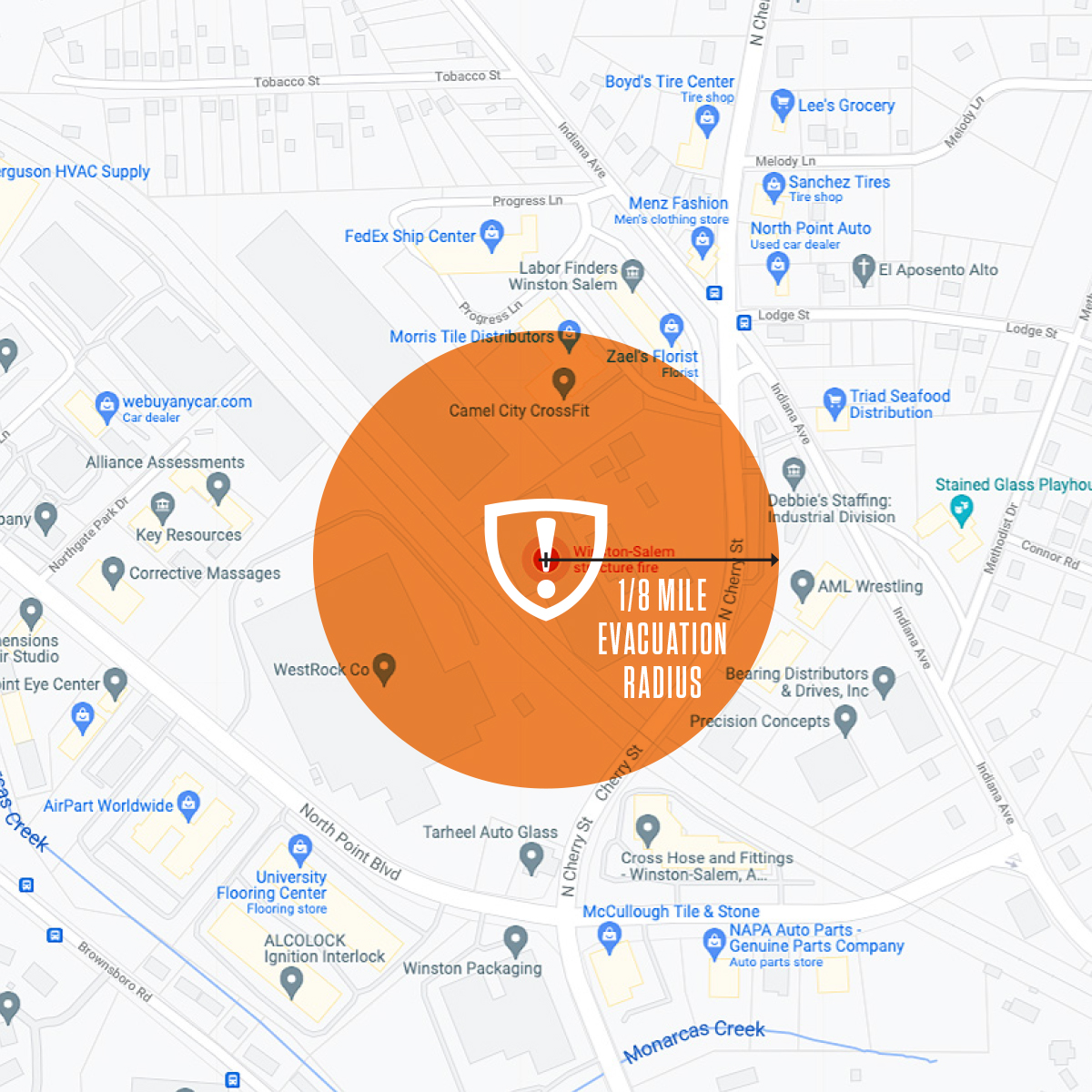
Classes canceled for Thursday, Feb. 3, and Friday, Feb. 4
Following the University’s announcement today that classes and normal operations would resume tomorrow, we received additional information from students and families regarding the scope and degree of challenges faced by those displaced. This understanding has informed a decision by academic leadership to cancel classes on the Reynolda Campus, Wake Downtown and Brookstown for the remainder of the week – Thursday, Feb. 3, and Friday, Feb. 4. Classes at Wake Forest’s other locations will continue to operate normally. It is important to understand that this decision will have significant effects on the academic calendar. To ensure we provide the needed number of instructional days this semester, the Provost and academic deans will determine how the four days missed this week will be made up during the remainder of this semester. Make-up dates will be shared soon. The Reynolda Campus remains open, with all administrative and student support offices operating. Scheduled campus activities may continue at the discretion of event organizers. Conversations with local officials this afternoon, including the Winston-Salem Fire Department Chief, confirmed that areas outside the one-mile voluntary evacuation radius are safe to continue operations. All K-12 schools in Winston-Salem are open with the exception of one that lies within the voluntary evacuation area. In addition, EPA air-quality readings on and near campus continue to indicate that the air currently poses no threat to individual health and is safe to breathe. Intermittent smoke could cause irritation for those with respiratory concerns, and public health officials continue to advise people to avoid being outside for prolonged periods when smoke is present. We understand the past several days have been challenging, and the decisions have come quickly. Please know that we are here to support you. For questions, including urgent housing needs, students and families should contact the University Call Center at 336-758-7500, which will be open until 9 p.m. EST tonight and will be open 9 a.m.-9 p.m. EST tomorrow. Wake Forest will continue to monitor the situation and provide additional information and direction as it becomes available.Classes will resume in person on Thursday, Feb. 3
Based on updated safety information from emergency responders and city officials and after in-depth discussions among the University’s leadership, the Reynolda campus, Wake Downtown and Brookstown will resume in-person classes on Thursday, Feb. 3. Normal operations also will resume for staff. Students displaced by the voluntary evacuation are receiving support as needed, and campus operations have stabilized. Students with urgent housing needs should contact the Student Support Center at 336-758-3473 from 9 a.m. to 9 p.m. We understand that accommodations and flexibility related to resuming classes for displaced students may be needed. As a result, we ask that faculty work with students based on these unique circumstances. Please note that ZSR Library has public computing stations and Chromebooks that can be checked out by students, as well as lockers to store personal belongings. The voluntary evacuation request remains in effect for the one-mile radius from 4440 N. Cherry Street and the evacuation is likely to extend longer than the 48-hour period originally anticipated. If you have evacuated from housing within the one-mile radius, you should not return to your residence until the evacuation request is lifted. Normal parking restrictions will not be enforced on campus until the evacuation has been lifted. The Environmental Protection Agency has established air-quality monitoring on the Reynolda campus and in the surrounding area. Monitoring stations are moved periodically to gather data from different locations in response to shifting weather and wind patterns. As of Wednesday morning, the EPA reports that air-quality readings on and near campus indicate that the air poses no threat to individual health and is safe to breathe. We are receiving real-time information and will provide updates and direction should conditions change. In addition, the Winston-Salem Fire Department, Forsyth County Environmental Assistance and Protection, and the Wake Forest Environmental Health and Safety office are also conducting air sampling to confirm results. Although the air is safe to breathe, the smoke could cause irritation, especially for people with respiratory issues, therefore public health officials are advising people to avoid being outside for prolonged periods when smoke is present. As the fire continues to burn, wind and weather conditions will affect the amount of smoke visible on campus. Wake Forest will continue to monitor the situation and provide additional information and direction as it becomes available.Classes canceled on Wednesday, Feb. 2
Out of an abundance of caution and in response to the continued disruption and displacement of students, faculty, and staff living in the voluntary evacuation zone, Wake Forest will cancel classes on Wednesday, Feb. 2. Staff who are not needed to support the evacuation effort and are able to work remotely are encouraged to do so. If you are unsure if you should report to campus, contact your supervisor. The evacuations have had an impact on campus operations and preparedness to conduct classes. Some faculty and staff and more than 1,000 students reside in the one-mile evacuation radius. Voluntary evacuation remains in effect and is expected to continue until at least 7 p.m. tomorrow (Wednesday) night. Residents of the area should not return to their homes until notified it is safe to do so. It remains safe for students to be on Reynolda campus. Local officials have been and continue to monitor readings from air monitoring equipment on and around campus and have found no health concerns for the Reynolda Campus. Those with pre-existing respiratory conditions may choose to avoid being outside for prolonged periods. The Benson Center, Wellbeing Center and ZSR Library will operate under normal hours tonight and tomorrow. Please remember to wear face masks when in campus buildings. Students with questions regarding urgent housing concerns should contact 336-758-3473. The Student Support Center in the Wellbeing Center remains available in conference room A330, and students also can email housing@wfu.edu. We anticipate providing the next update to the campus community tomorrow morning. We encourage students, faculty, and staff to be careful and remain vigilant when navigating around the city.Update on fire and evacuation
On Monday evening, a fire at the fertilizer plant at 4440 N. Cherry Street in Winston-Salem led to the Winston-Salem Fire Department asking for the evacuation of residents living within a one-mile radius. Faculty, staff and students who reside inside that radius are encouraged to leave the area. The Winston-Salem Fire Department said that the evacuation request will be in place until around 11 p.m. on Wednesday, Feb. 2 and then will be reassessed. The evacuation area does not include on-campus housing, with the exception of Deacon Place, which is within the one-mile evacuation radius. Campus staff and the Winston-Salem Fire Department continue to monitor air quality and at this time have not found any harmful issues in the campus area. The University will be helping to relocate students who need overnight housing. Any evacuated students who need assistance finding a place to stay on Tuesday night should check in at the Support Center in the Wellbeing Center in conference room A330. If you are not able to check in at the Wellbeing Center, you also can email housing@wfu.edu. Classes, as well as academic and other planned outdoor activities, are canceled today. Staff who are not needed to support the evacuation effort and are able to work remotely are encouraged to do so. If you are unsure if you should report to campus, contact your supervisor. Worrell Professional Center is card-access only today, and the LAM Museum of Anthropology is closed. North Dining Hall will be closed today to focus staffing resources at other locations. All other dining options remain open. Shuttles are not running today. An on-call shuttle is available until midnight tonight. To request a ride, please call 336-283-1091. Deacon Place has a shuttle in the parking lot for students who would like to evacuate to campus. Human Resources will communicate additional employee resources and guidance for entering time in Workday later today. Faculty and staff can contact askhr@wfu.edu with questions. Students on campus or living outside of the one-mile radius are encouraged to stay indoors and keep their windows closed. Please remember to wear face masks when in campus buildings. Expect smoky conditions. Masks are recommended outdoors. Outdoor gatherings and events are discouraged. The Student Health Service will be open until 5 p.m. to provide confidential health care to students who may be affected by smoke and fumes. If you need assistance after hours, please call 336-758-5218. For counseling, students can reach the University Counseling Center at 336-758-5273. TimelyCare, a 24/7 resource at timelycare.com/wakeforest, is also available. Faculty and staff can use the Employee Assistance Program by calling 336-716-5493. Additional updates will be shared as the situation evolves.Classes canceled for Tuesday, Feb. 1; overnight housing available for those evacuating
Because of the impact of the fire on North Cherry Street, Wake Forest will cancel classes on Tuesday, Feb. 1. Staff who are not needed to support the evacuation effort and are able to work remotely are encouraged to do so. If you are unsure if you should report to campus, contact your supervisor. Wake Forest has opened the Wellbeing Center, Benson Center and ZSR Library for faculty, staff or students who are evacuating and are not able to stay with friends or family outside of the one-mile evacuation radius. Those buildings will remain open all night. You may wish to bring a sleeping bag, pillow, and/or blanket to be comfortable, as well as any other necessary personal belongings. Please remember to wear face masks when in campus buildings. Wake Forest has set up a Student Support Center in the Wellbeing Center in conference room A330. Faculty and staff can contact askhr@wfu.edu with questions. Travel in the evacuation area around 4400 North Cherry Street will become increasingly difficult as police begin to shut down roads and prohibit vehicle traffic. Faculty, staff and students are encouraged to evacuate as soon as possible. Use personal vehicles and carpool when possible. Parking anywhere on campus is allowed. Wake Forest will operate the on-call shuttle as long as possible to aid with evacuations, but please use this as a last resort. Call 336-283-1091 to request a shuttle. The evacuation area does not include on-campus housing, with the exception of Deacon Place, which is within the one-mile evacuation radius. The Winston-Salem Fire Department says that the evacuation order will be in place for 48 hours (until around 11 p.m. on Wednesday, Feb. 2) and then will be reassessed. If you are evacuating, take personal belongings needed for at least that period of time. Students on campus or living outside of the one-mile radius are encouraged to stay indoors and keep their windows closed. Students who are off-campus and are in quarantine or isolation will receive direct communication from Residence Life and Housing. These students also can email getwell@wfu.edu for information. Additional updates will be shared as information evolves. The best source of information about the fire is the official Twitter page for the Winston-Salem Fire Department: @cityofwsfire.Voluntary evacuations requested for some areas of off-campus housing
Because of a fire at 4440 N. Cherry Street, the Winston-Salem Fire Department is asking for voluntary evacuations by residents within a one-mile radius of that address. That includes off-campus housing north of Polo Road between Cherry Street and Long Drive. (See image of one-mile radius.) On-campus housing is not included in the evacuation. Any faculty, staff or students in the area who can evacuate should do so. If possible, stay with friends or family who are outside the one-mile radius. The University is currently working on long-term plans for those who do not have an alternative place to go, and those plans will be communicated as soon as possible. Campus buildings that are currently open include the Wellbeing Center, Benson University Center and ZSR Library. You may wish to bring a sleeping bag, pillow, and/or blanket to be comfortable if the evacuation lasts more than a short time. You may consider taking the necessary personal belongings needed for several hours should the evacuation remain in place. Motorists are also advised to avoid driving in this area. Students on campus or living outside of the one-mile radius are encouraged to stay indoors and keep their windows closed. The best source of information about the fire is the official Twitter page for the Winston-Salem Fire Department: @cityofwsfire.University Police Advisory: No evidence found of gun after report
Tonight, the University Police received a report of someone who was believed to be carrying a gun on campus near Olin Hall. University Police and Winston-Salem Police canvassed the area and did not find any evidence of anyone with a gun. Police are continuing to circulate in the area; no threat to campus has been identified. As always, stay alert on campus and report anything unusual. If you have any information that might be helpful in this investigation, contact the University Police at 336-758-5911. If you wish to provide information anonymously, do so through “Silent Witness.” It is important for all of us to focus on the things that we can all do to keep ourselves and others safe.- Call 911: If you feel uneasy or unsafe, go to a safe location and call a friend or the police at 911. If you feel you need a safe escort on campus, contact University Police, available 24 hours at 336-758-5911.
- Download the Live Safe Mobile App.
- Emergency Blue Light Call Boxes are located throughout campus [PDF Map]. Push the button once to speak with a dispatcher.
- Telephone Boxes are located near some building entrances. Pick up the receiver and dial 911 to reach a dispatcher.
Update on this morning’s emergency alerts
Early this morning, the University received anonymous phone calls with shooting-related threats. An emergency shelter-in-place message was sent while University Police and Winston-Salem Police investigated the threat. At 5 a.m., an all-clear message was shared as the call was determined to be a hoax. It is safe for students, faculty and staff to resume regular activities. Classes will be held on a normal, in-person schedule, and all student services will be open. Police will continue to investigate the threat, which appeared to be a prank call to emergency services in an attempt to dispatch a large number of armed police officers around campus. These “swatting” calls cause great distress among those who are affected by them. Recently, the Winston-Salem Police Department and Forsyth County Sheriff’s Office have responded to similar incidents with no identified threats. Local law enforcement are working with federal and state officials to identify the callers who made the threats. Nationally, many colleges and universities have received threats since November 2021, prompting lockdowns and evacuations. Out of an abundance of caution, University Police will staff and close the gates to campus over the weekend. Winston-Salem Police have increased patrols on campus and in the surrounding area. The University’s first concern is for our community. This hoax disrupted the sense of safety for our students, faculty and staff and will have affected each one of us differently. Wake Forest offers a variety of support and counseling services for all students, faculty and staff. The following University resources are available for confidential information and support:- For counseling, students can reach the University Counseling Center at 336-758-5273. TimelyCare, a 24/7 resource at timelycare.com/wakeforest, is also available.
- Faculty and staff can use the Employee Assistance Program by calling 336-716-5493.
- The Office of the Chaplain is available to all members of our community at 336-758-5017.
Emergency Update message: All clear; shelter in place lifted
Early this morning an anonymous caller made numerous threats related to a shooting on Wake Forest’s campus. University Police and Winston-Salem Police conducted a thorough sweep of threatened buildings without finding any evidence to support the claims of the caller. Police believe the calls were a hoax. Police will continue to investigate the threat. Anyone with information is asked to contact University Police at 336-758-5911. Wake Forest offers a variety of support and counseling services for all students, faculty and staff. For counseling, students can reach TimelyCare, a 24/7 resource, at timelycare.com/wakeforest or the University Counseling Center at 336-758-5273 (after 8:30 a.m.). Faculty and staff can use the Employee Assistance Program by calling 336-716-5493. The Office of the Chaplain is available to all members of our community by calling 336-758-5017 (after 8:30 a.m.).Emergency Update message
University Police and Winston-Salem Police continue to investigate the shooting threat to campus. Police are checking buildings. Continue to shelter in place until further notice. Call if you have any information to assist in this investigation. 336-758-5911.Emergency Update message
University police and Winston-Salem Police continue to investigate the shooting threat to campus. Police are checking buildings. Continue to shelter in place until further notice. Call if you have any information to assist in this investigation. 336-758-5911.Emergency Update message
University Police are working with the Winston-Salem Police Dept. to investigate a shooting threat. Anyone with information is asked to contact University Police at 336-758-5911. Due to the high volume of calls, DO NOT CALL UPD unless you have an emergency or information to report. Continue to shelter in place until further notice.Shelter in place
Wake Alert Emergency: A THREAT HAS BEEN MADE AGAINST WAKE UNIVERSITY COMMUNITY. POLICE ARE INVESTIGATING AT THIS TIME, PLEASE SHELTER IN PLACE. FURTHER MESSAGES TO FOLLOW.Normal operations for Reynolda Campus, Wake Downtown on Thursday, Jan. 20
Reynolda Campus and Wake Downtown will return to in-person classes and normal campus operations on Thursday, Jan. 20. Forsyth County and surrounding areas may experience additional inclement weather Thursday evening through Saturday morning. This may impact campus operations starting on Thursday night, and faculty, staff and students should check websites to confirm night-time operating hours. Colleagues whose work may be performed remotely are encouraged to prepare for the possibility of shifting work modalities on Friday. Employees who are unable to perform their work due to extenuating circumstances should use Paid Time Off. The University will continue to update the campus community on any major operational changes. Directions to sign up for text alerts are available here.Weather-related updates for Reynolda Campus and Wake Downtown
Due to icy travel conditions locally in some areas in the morning, Reynolda Campus and Wake Downtown classes will continue in remote learning mode for Wednesday, Jan. 19. The ability to offer remote classes helps to maintain the continuity of the academic calendar and is less disruptive to the continuity of classes throughout the day. Campus support services and offices will open by 10 a.m. With approval from supervisors, staff with the ability to work remotely may choose to do so. Staff who are asked to report on-site and are concerned about traveling should contact their supervisor. Note that the Pit will be open by 8 a.m. Other dining venues will open as staffing permits. The ZSR Library will update its website if an earlier opening is possible. Shuttles will operate beginning at 10 a.m. A link to the shuttle schedule can be found here.Weather-related changes for Reynolda Campus and Wake Downtown
Because of icy roads and dangerous driving conditions, all classes and administrative offices will shift to remote operations tomorrow, Jan.18. Faculty and staff should avoid traveling to campus and work remotely if possible. Staff who have been asked to report on-site and are concerned about traveling should contact their supervisor. Classes will be held virtually. Faculty who face challenges with remote instruction may contact their chair or deans’ offices for guidance. Campus services hours for Tuesday:- The Pit will open at 8 a.m. Other dining venues will open as staffing permits. The Deacon Dining website will be updated throughout the day.
- The Wellbeing Center will open at 10 a.m. Follow @wfucampusrec on Instagram for information on facility hours or visit the Campus Rec website.
- ZSR Library will update its website with operating information.
- The Student Health Service will be open from noon to 4 p.m.
- Shuttles will not be operating tomorrow. A link to the shuttle schedule can be found here. On-Call service may operate when road conditions improve.
Winter Storm Warning
A Winter Storm Warning is in effect from midnight tonight through midnight Sunday evening. Precipitation will initially begin as snow before changing to a mix of snow, sleet and freezing rain. Snow accumulations of 2 to 3 inches and ice accumulations of one-third of an inch are predicted. Wind gusts up to 45 mph are expected. Tree damage is likely due to the ice and wind. Widespread power outages are likely. Travel will be dangerous with snow and ice accumulations. According to the N.C. Department of Transportation, there may be delays in snow removal after the storm because of staffing shortages. Plan accordingly. Faculty, staff and students are encouraged to stay alert to weather forecasts. Visit Wake Ready for instructions on how to add or update your cell phone number to receive messages and alerts. University employees scheduled to work on Saturday evening and Sunday morning should use their best judgment when deciding whether to come to campus. If you are scheduled to work from campus and are concerned about traveling, contact your supervisor. Wake Forest work-study students living off-campus who are scheduled to work on Sunday morning should contact their supervisors with any weather-related travel concerns. Some services will likely need to adjust hours of operations based on weather conditions. Students should check individual campus service websites for any change in hours of operation this evening and tomorrow. Keep devices charged in case of a power outage. In the event of snow, ice or freezing rain:- Remain inside as much as possible.
- Stay clear of icy trees, rooftops and power lines as falling ice is dangerous.
- Do not walk near ice and snow removal equipment.
- Watch for slick spots as you walk.
Community Advisory Update
Earlier this morning, Winston-Salem Police Department officers found the body of a 74-year-old man on campus near Polo Road and Martin Residence Hall. There is no foul play suspected and no Wake Forest students, faculty or staff were involved in the incident. Because the incident occurred on campus, the University is providing an update to the campus community based on information provided by the Winston-Salem Police Department. The Wake Forest community grieves with all those impacted by this tragic loss of life, and we invite any who feel affected to reach out and seek support. Wake Forest offers a variety of support and counseling services for all students, faculty and staff. For counseling, students can reach the University Counseling Center at 336-758-5273 and faculty and staff can use the Employee Assistance Program by calling 336-716-5493. The Office of the Chaplain is available to all members of our community by calling 336-758-5017. Please do not hesitate to seek support.Community Safety Advisory: Police investigating incident near Polo Road and Martin Residence Hall, no threat to campus
Winston-Salem Police and University Police have responded this morning to an incident reported near Polo Road, behind Martin Residence Hall. There is no known WFU community involvement or threat to the campus community. More details will be shared if they are made available by the Winston-Salem Police. If you have any information that might be helpful in this investigation, contact the University Police at 336-758-5911 or, if you wish, anonymously through “Silent Witness.”Test of Emergency Alert Systems
This is a TEST of the Wake Alert System. The test is being conducted to assure that the emergency notification system is operating properly. Testing is being carried out by the University Police Department and the Office of Communications and External Relations. No action is required in response to this message. Emergency procedures can be viewed at Wake Ready.Community Safety Advisory: Shooting on University Parkway
Wake Forest is aware of the following incident in our surrounding community on Monday, Nov. 1. Winston-Salem Police responded to a report made at 9:23 p.m. of a shooting in the 3100 block of University Parkway. A white SUV fired shots into a vehicle stopped at a stoplight, injuring a woman. No arrests have been made. The incident occurred off campus, and there is no WFU community involvement. Additional information will be shared if the situation affects the safety of the Wake Forest community. The official Twitter page for the Winston-Salem Police Department is @CityofWSPolice. If you have any information that might be helpful related to this incident, contact University Police at (336) 758-5911. As a reminder, the LiveSafe Mobile App allows Wake Forest students, staff, and faculty to have a two-way conversation with University police. It provides direct access to police, 911 emergency services, emergency location sharing, information sharing with quick tips, and a peer-to-peer Safe Walk tool.Community Safety Advisory: Reports of drugs added to alcohol
Wake Forest is issuing this public awareness announcement about an issue of concern for the campus community. Wake Forest University Police have received three reports this semester alleging that a student was given a drink that had been drugged. The most recent incident was reported this weekend. Wake Forest takes these allegations seriously, and the Winston-Salem Police Department is investigating the latest incident. Students are reminded that putting a drug in another person’s drink is illegal and dangerous. In addition to being a crime, inducing incapacitation violates the University’s Student Code of Conduct and our culture of valuing each other with respect and dignity. The following are personal safety recommendations for environments where alcohol is served:- Know what you’re drinking.
- Don’t leave a drink unattended.
- Don’t accept drinks from people you don’t know or trust.
- Be aware of sudden changes in how your body feels. Signs a drink may have been drugged include feeling woozy, drowsy, having trouble making decisions, difficulty in moving or controlling your muscles, and/or experiencing mental confusion.
- Seek medical attention immediately. Many of these drugs leave the body quickly, within 12 to 72 hours.
Winston-Salem/Forsyth County Resources:
Winston-Salem Police Department 336-773-7700 911 in an emergency Family Services/Forsyth County 24/7 Sexual Assault help line: 336-722-4457 24/7 Domestic Violence help line: 336-723-8125 Wake Forest Baptist Medical Center [Confidential] Medical Center Blvd, Winston-Salem, NC 27157 Novant Health Forsyth Medical Center [Confidential] 3333 Silas Creek Pkwy, Winston-Salem, NC 27103Community Safety Advisory
Community Safety Advisory: Wake Forest is aware of the following incident in our surrounding community: Winston-Salem Police responded this afternoon to a report of a firearm discharged on Scholastic Court. The incident occurred off-campus, and there is no known Wake Forest student or faculty involvement. Additional information will be shared if the situation affects the safety of the Wake Forest community. The official Twitter page for the Winston-Salem Police Department is @CityofWSPolice. If you have any information that might be helpful related to this incident, contact University Police at (336) 758-5911. As a reminder, the LiveSafe Mobile App allows Wake Forest students, staff, and faculty to have a two-way conversation with University police. It provides direct access to police, 911 emergency services, emergency location sharing, information sharing with quick tips, and a peer-to-peer Safe Walk tool.Community Safety Advisory: Police investigating gunshots on Delmonte Drive
Wake Forest is aware of the following incident in our surrounding community: The Winston-Salem Police Department responded to a report of a firearm discharged into a truck parked near apartments on Delmonte Drive, off Polo Road. Police are reporting that they do not believe the suspect is still in the area and that no members of the Wake Forest community were involved. Additional information will be shared if the situation affects the safety of the Wake Forest community. The official Twitter page for the Winston-Salem Police Department is @CityofWSPolice. If you have information related to this incident, contact University Police at (336) 758-5911. As a reminder, the LiveSafe Mobile App allows Wake Forest students, staff, and faculty to have a two-way conversation with University police. It provides direct access to police, 911 emergency services, emergency location sharing, information sharing with quick tips, and a peer-to-peer Safe Walk tool.Community Safety Advisory
Wake Forest is aware of the following incident in our surrounding community: Winston-Salem police responded this evening to a report of a firearm discharged at the Whiskey Dog Bar on Brookstown Ave. The shooting occurred off-campus. No students were involved. Additional information will be shared if the situation affects the safety of the Wake Forest community.Suspect arrested in Mount Tabor shooting
The suspect in today’s shooting at Mount Tabor High School is in custody. Today’s incident may prompt difficult emotions. Faculty, staff and students are encouraged to take advantage of support resources.- The University Counseling Center and Office of the Chaplain are available to listen to students who need to speak with someone here. The Counseling Center provides crisis assistance for urgent mental health needs 24 hours a day at 336.758.5273.
- The Emergency Assistance Program is available to faculty and staff for assessment, referral and follow-up services.
Update on Mount Tabor school shooting
Wake Forest Police remain in contact with local authorities who continue to search for the suspect in the shooting at Mount Tabor High School. There is no reason to believe there is any risk to campus. Campus will be updated should the risk in our area change. Faculty, staff and students should remain alert to new information while continuing normal activities. Winston-Salem public schools and police have confirmed a single incident resulting in injuries to one high school student. No other incidents have been confirmed. All precautionary lockdowns have been lifted at other local public schools, other than at Mount Tabor. Wake Forest offers its support to faculty, staff and students who may need personal support:- The University Counseling Center and Office of the Chaplain are available to listen to students who need to speak with someone here. The Counseling Center provides crisis assistance for urgent mental health needs 24 hours a day at 336.758.5273.
- The Emergency Assistance Program is available to faculty and staff for assessment, referral and follow-up services.
Mount Tabor follow up
Update: Harris Teeter is no longer the reunification point. Parents of Mount Tabor students will be notified. Wake Forest Police are in contact with local law enforcement. No reason to believe the suspect in reported Mount Tabor H.S. shooting is on or near campus. Remain alert as you continue normal movement around campus. Parents of Mount Tabor students should now report to the Harris Teeter and NOT to the Robinhood YMCA to be reunited with their children. Please follow WSPD, FCSO, and WSFCS social media for the latest updates. @cityofwspolice @gofcsoncShooting at Mount Tabor
A shooting has been reported at Mount Tabor High School, about three miles from campus. Please monitor WFU emails and local news sources as information develops.Operating Status Normal
Wake Forest University is operating normally. Please visit Wake Ready for emergency preparedness information. This message will remain in place until the University’s operating status changes.Test of Emergency Alert Systems
This is a TEST of the Wake Alert System. The test is being conducted to assure that the emergency notification system is operating properly. Testing is being carried out by the University Police Department and the Office of Communications and External Relations. No action is required. Emergency procedures can be viewed at Wake Ready.Update: Police are continuing investigation; no updates expected tonight
Winston-Salem police are continuing to investigate the robbery at the BP station on University Parkway. The suspects remain at large. No further updates are expected tonight. Anyone with information that may assist in the investigation is asked to contact Wake Forest University Police at 336-758-5911.Update: Armed robbery at BP station; no threat to Best Western
Update: Armed robbery at BP station. No threat to Best Western. Winston-Salem Police are investigating and tracking suspects. Stay alert if in the area. Updates: wakealert.wfu.edu.Dangerous Suspect
Wake Alert Emergency. 3050 University Parkway, Best Western. A dangerous suspect was reported. Seek shelter now. Close and lock doors and windows, if possible. Stay in place until further notice. If you are off campus, stay away. Police are responding. Our first priority is to ensure the health and safety of those on our campus. Updates will appear here.University Operating Level: Yellow -- New Normal Campus Operations
Positive cases of COVID-19 among our University community are steady. Impacted individuals are isolating and quarantining. Continue social distancing, wearing masks, and washing hands. Consult healthcare providers, state and local health authorities, and CDC guidelines for information. See details about the operating status system and a dashboard of positive cases »Wake Forest classes canceled for Thursday, Feb. 18
A Winter Storm Warning is in effect for Winston-Salem and surrounding areas from midnight tonight until 7 a.m. Friday. Due to the potential for ice accumulation and significant power outages, all Reynolda Campus undergraduate and graduate school classes have been canceled for Thursday, Feb. 18, regardless of modality. Hazardous conditions could make travel extremely difficult throughout the day and evening tomorrow. University employees scheduled to work on-site should use their best judgment when deciding whether to come to campus. If you are scheduled to work from campus and are concerned about traveling, contact your supervisor. If you experience a power outage and are unable to work remotely, you may use Administrative Leave time and should notify your supervisor if possible.- University shuttles will not operate Thursday.
- The Pit will open at 9 a.m. Other dining options will open as staffing allows.
- The lower gym at the Sutton Center will open at 11 a.m. as a study space.
- Farrell Hall will be closed to students on Thursday.
- If you need medical attention, Student Health will be open with limited services from 9 a.m. - 4 p.m. Please email apptsshs@wfu.edu to make an appointment or call (336) 758-5218 to speak to someone if you have urgent needs. Please call the clinic after hours if you have any medical problems.
- If you live in University Housing, notify Facilities and Campus Services at 336-758-4255.
- If you live at Crowne Properties or other off-campus properties, notify Duke Energy (1-800-769-3766) of power outages and let your landlord or property management know about other issues.
University Operating Level: Orange -- Modified Campus Operations
The number of positive cases of COVID-19 and/or other public health indicators are unstable. Impacted individuals are isolating. Continue social distancing, wearing masks, and washing hands. Consult healthcare providers, state and local health authorities, and CDC guidelines for information. See details about the operating status system and a dashboard of positive cases »Classes cancelled for rest of today (10/29)
Because of power and internet outages as well as dangerous travel conditions, Wake Forest University has cancelled all classes for the remainder of today, Thursday, Oct. 29. Students should communicate directly with faculty about any issues related to outages and classes that occurred before this notification. On campus and in surrounding Wake Forest properties, power and internet connections may continue to be intermittent while repair work is completed. Trees and limbs are down on campus, and crews are working to clear them. Faculty, staff and students on campus should limit movement as much as possible. Off-campus faculty, staff and students should only come to campus for essential reasons and should use caution in traveling because of road closures, downed trees, debris from wind damage and other potential hazards. For the most up-to-date information on campus dining options, including potentially revised hours of operation, please go to dining.wfu.edu/menu-hours. Shuttle service may be slow or delayed in some cases because of road conditions, and service will end early:- Gold/Black Lines - last departure from campus will be 2:50 p.m.
- Gray Line - last departure will be 2:40 p.m.
- Wake Downtown - last departure from campus will be 2:25 and last departure from Wake Downtown will be 2:40
- Deacons Station - last departure from campus will be 2:35 p.m.
- Faculty/Staff onCall - service stops at 3 p.m.
- Student OnCall - no service tonight
University Operating Level: Orange -- Modified Campus Operations
Confirmed on-campus COVID-19 cases have increased. Impacted individuals are isolating. Continue social distancing, wearing masks, and washing hands. Consult healthcare providers, state and local health authorities, and CDC guidelines for information. See details about the operating status system and a dashboard of positive cases »Test of Emergency Alert Systems
This is a TEST of the Wake Alert System. The test is being conducted to assure that the emergency notification system is operating properly. Testing is being carried out by the University Police Department and the Office of Communications and External Relations. No action is required.University Operating Level: Yellow -- New Normal Campus Operations
COVID-19 cases are manageable and transmission is controlled. Check health and temperature daily, wear face coverings and practice physical distancing. Comply with limitations for gathering sizes and social interactions. See details about the operating status system and a dashboard of positive cases »Tornado watch over; operating status normal
The tornado watch for Winston Salem/Forsyth County for today, Feb. 6, has expired. Wake Forest University is operating normally. Please visit Wake Ready for emergency preparedness information. This message will remain in place until the University’s operating status changes.Tornado Warning to Watch
The National Weather Service tornado warning has expired. A tornado watch for the Winston-Salem/Forsyth County area remains in effect until 12:00 p.m A tornado watch means tornadoes are possible in and near the watch area. Please monitor local weather reports for the latest information. Resources include: TV Stations: WXII, WFMY, WGHP or Spectrum News Triad National Weather Service The University recommends keeping cell phones charged and set to receive calls and text messages. Updates will be posted here. In the event of a tornado warning, Wake Forest will use the Wake Alert emergency notification system to communicate with students, faculty, and staff. An announcement would be posted on the Wake Alert web site and the University’s home page at wfu.edu; sent by text, email and voice mail; and posted on the Wake Alert Twitter and Facebook accounts.Tornado Warning
Wake Alert Emergency. The National Weather Service has issued a tornado warning for the Winston-Salem/Forsyth County area. Seek shelter now. Go to the lowest level of a building. Stay away from doors and windows. Our first priority is to ensure the health and safety of those on our campus. The current NWS warning is in effect until 05:30 a.m. Updates will appear here.Tornado Watch
The National Weather Service has issued a tornado watch for the Winston-Salem/Forsyth County area. A tornado watch means tornadoes are possible in and near the watch area. The current NWS watch is in effect 12:00. p.m. Please monitor local weather reports for the latest information. Resources include: TV Stations: WXII, WFMY, WGHP or Spectrum News Triad National Weather Service The University recommends keeping cell phones charged and set to receive calls and text messages. Updates will be posted here. In the event of a tornado warning, Wake Forest will use the Wake Alert emergency notification system to communicate with students, faculty, and staff. An announcement would be posted on the Wake Alert web site and the University’s home page at wfu.edu; sent by text, email and voice mail; and posted on the Wake Alert Twitter and Facebook accounts.First On-Campus COVID-19 Case Confirmed at Wake Forest
Dear Wake Forest Community, Public Health officials have confirmed late this afternoon that a Wake Forest student who is currently in isolation in an on-campus residence hall has tested positive for COVID-19. In compliance with the requirements of the Clery Act, the University is sending this Emergency Notification to the campus community. After returning from a Wake Forest-sponsored trip to London, the student began exhibiting mild symptoms and was isolated from others in a residence hall after being seen by Student Health on Wednesday, March 18. The student is currently recovering well. Other members of our community may have come into contact with the student on campus. Though we are not able to share the student's name or identifying information for privacy reasons, please be assured that professionals from the Student Health Service and the Forsyth County Health Department are working to notify any community members with whom the affected student indicates they may have come in contact to advise them of steps or precautions they should take. The University also has contacted the other individuals who were on the same sponsored trip abroad. Wake Forest previously reported its first off-campus case on March 21 and is now aware of other students who are not on campus who have tested positive for the virus. The University is also monitoring another student on campus who is in isolation after exhibiting symptoms. With increasing numbers of positive COVID-19 cases in North Carolina and around the country, the number of students with COVID-19 on campus may increase as well. The University will continue to follow the guidance of public health officials. Students, faculty and staff presenting symptoms of COVID-19 must immediately self-isolate. Students remaining on campus or in the local Winston-Salem area who develop symptoms can call the Student Health Service (336-758-5218) or their primary care provider for medical advice. Students who reside outside of the Winston-Salem area should contact their primary care provider or local public health department for guidance. Also, faculty and staff who exhibit symptoms should contact their primary care provider or local public health department for guidance. Continue to practice social distancing per the guidelines of the CDC. The University will follow recommendations of public health officials and infectious disease experts to further reduce community transmission of the virus. The University has reduced the density of our campus population to slow the spread of the virus and avoid overwhelming health care and community systems. Wake Forest has moved all course instruction to remote delivery, requested that employees work remotely if possible, and reduced the number of students who are permitted to remain in residence halls. The University does have employees who are deemed essential working on campus. We continue to monitor this rapidly changing situation. The health and wellbeing of our campus community continues to be our highest priority. The best place to find information on Wake Forest’s response to coronavirus is at coronavirus.wfu.edu.Coronavirus (COVID-19) information available on WFU website
Wake Forest has an incident management team that is actively monitoring the novel coronavirus (COVID-19) situation. To find out the latest information regarding coronavirus and Wake Forest, please visit ourwayforward.wfu.edu.Wake Forest to open at 10 a.m. Friday Feb. 21
The Reynolda Campus of Wake Forest University will open at 10 a.m. Friday, Feb. 21. This includes Wake Downtown. Classes will not meet until 10 a.m. Offices will open at 10 a.m. The University’s shuttles will begin operating at 8:20 a.m. For those planning to attend events on campus Friday, check with the host or sponsoring organization. Conditions will vary in the region, so please use your best judgment regarding your own safety. Please see the Wake Alert website at wakealert.wfu.edu for any other announcements that may be made,Tornado watch over; operating status normal
The tornado watch for Winston Salem/Forsyth County for today, Feb. 6, has expired. Wake Forest University is operating normally. Please visit Wake Ready for emergency preparedness information. This message will remain in place until the University’s operating status changes.Tornado warning expired; watch remains
Wake Alert update: The tornado Warning for Winston Salem/Forsyth County today, Feb. 6, has expired. The tornado watch for the area remains in place until 5 p.m. today.Tornado Warning
Wake Alert Emergency. The National Weather Service has issued a tornado warning for the Winston-Salem/Forsyth County area. Seek shelter now. Go to the lowest level of a building. Stay away from doors and windows. Our first priority is to ensure the health and safety of those on our campus. The current NWS warning is in effect until 11:45 a.m. today. Updates will appear here.Tornado Watch
The National Weather Service has issued a tornado watch for the Winston-Salem/Forsyth County area. A tornado watch means tornadoes are possible in and near the watch area. The current NWS watch is in effect until 5 p.m. today. Please monitor local weather reports for the latest information. Resources include: TV Stations: WXII, WFMY, WGHP or Spectrum News Triad National Weather Service The University recommends keeping cell phones charged and set to receive calls and text messages. Updates will be posted here. In the event of a tornado warning, Wake Forest will use the Wake Alert emergency notification system to communicate with students, faculty, and staff. An announcement would be posted on the Wake Alert web site and the University’s home page at wfu.edu; sent by text, email and voice mail; and posted on the Wake Alert Twitter and Facebook accounts.Operating status normal
Wake Forest University is operating normally. Please visit Wake Ready for emergency preparedness information. This message will remain in place until the University’s operating status changes.Tornado Watch Remains; Disregard Severe Weather Message
A severe weather announcement was sent in error. Please disregard. The National Weather Service still has a tornado watch for the Winston-Salem/Forsyth County area until 11 p.m. A tornado watch means tornadoes are possible in and near the watch area. Please monitor local weather reports for the latest information. Resources include: TV Stations: WXII, WFMY, WGHP or Spectrum News Triad National Weather Service The University recommends keeping cell phones charged and set to receive calls and text messages. Updates will be posted on the Wake Alert website at wakealert.wfu.edu. In the event of a tornado warning, Wake Forest will use the Wake Alert emergency notification system to communicate with students, faculty, and staff. An announcement would be posted on the Wake Alert web site and the University’s home page at wfu.edu; sent by text, email and voice mail; and posted on the Wake Alert Twitter and Facebook accounts.Tornado Watch
The National Weather Service has issued a tornado watch for the Winston-Salem/Forsyth County area. A tornado watch means tornadoes are possible in and near the watch area. The current NWS watch is in effect until 11 p.m. Please monitor local weather reports for the latest information. Resources include: TV Stations: WXII, WFMY, WGHP or Spectrum News Triad National Weather Service The University recommends keeping cell phones charged and set to receive calls and text messages. Updates will be posted here. In the event of a tornado warning, Wake Forest will use the Wake Alert emergency notification system to communicate with students, faculty, and staff. An announcement would be posted on the Wake Alert web site and the University’s home page at wfu.edu; sent by text, email and voice mail; and posted on the Wake Alert Twitter and Facebook accounts.Operating status normal
Wake Forest University is operating normally. Please visit Wake Ready for emergency preparedness information. This message will remain in place until the University’s operating status changes.Timely Warning: Rape reported
In order to promote safety on the Wake Forest University campus, the University is issuing this Timely Warning concerning a possible threat to the community. The Winston-Salem Police Department and the University Police Department are investigating an alleged incident of rape that was reported to have occurred on Sept. 14, 2019, in Angelou Residence Hall. It was reported to police on Sept. 17, 2019. A student reported being raped by another student. The alleged victim reported that the suspect is known to them. If you have any information that might be helpful in this investigation, contact the University Police at (336) 758- 5911 or, if you wish, anonymously through “Silent Witness.” Wake Forest is providing resources to assist the individuals involved in this incident, and will continue to take actions to maintain the safety and security of the campus community. It is important for all of us to focus on the things that we can all do to keep ourselves and others safe. Call 911: If you feel uneasy or unsafe, go to a safe location and call a friend or the police at 911. When your safety is at risk or you need a safe escort on campus, contact University Police, available 24 hours at 336-758-5911. --Download Live Safe Mobile App --Ask a friend who may be in a potentially dangerous situation if they want to leave and then make sure that they get home safely. If you have experienced a sexual offense, we encourage you to seek support. If you or a friend has questions or concerns about sexual offenses, you can contact the following resources for confidential information and support: Safe Office: [Confidential] Helpline 24/7: 336-758-5285, Reynolds Gym, B104-107 (next to Student Health Service) Student Health Service: [Confidential] 336-758-5218, Lower Level of Reynolds Gymnasium Wake Forest Baptist Medical Center [Confidential] Medical Center Blvd, Winston-Salem, NC 27157 University Counseling Center: [Confidential] 336-758-5273, Reynolda Hall, Room 117 Office of the Chaplain: [Confidential] 336-758-5017, Reynolda Hall, Suite 8 If you would like to report a sexual offense, please contact any of the following offices: University Police 336-758- 5911 Wake Forest University Title IX Office 336-758-7258, Reynolda Hall, Room 307 To obtain information about sexual offense prevention, contact: Safe Office: [Confidential] Helpline 24/7: 336-758-5285, Reynolds Gym B104-107 University Police 336-758-5591 (non-emergency) Rape Aggression Defense (RAD) 336-758-5591 rad@wfu.edu Other resources: Winston-Salem Police Department 336-773-7700 911 in an emergency Family Services/Forsyth County 24/7 Sexual Assault helpline: 336-722-4457 24/7 Domestic Violence helpline: 336-723-8125 Novant Health Forsyth Medical Center [Confidential] 3333 Silas Creek Pkwy, Winston-Salem, NC 27103 This Timely Warning is sent in compliance with the provisions of the federal Jeanne Clery Disclosure of Campus Security Policy and Campus Crime Statistics Act of 1998.Crime Alert: Shot fired at University-owned house
The Winston-Salem and Wake Forest University police departments are investigating an incident tonight (Sept. 16) in which a bullet was fired into a University-owned house on Polo Road. None of the house’s occupants, all graduate students, were injured. Police believe the shot was fired at approximately 7:15 p.m. It was nearly an hour later before the residents of the house realized what had happened and contacted police. While the police continue their investigation, University staff members are offering support and assistance to the students who live in the house. Anyone with information that may assist in the investigation is asked to contact Wake Forest University Police at 336-758-5911.Operating status normal
Wake Forest University is operating normally. Please visit Wake Ready for emergency preparedness information. This message will remain in place until the University’s operating status changes.Public Awareness Announcement: Sexual Offense
UPDATE (9/5/19): Arrest made Wake Forest is issuing this public awareness announcement concerning a reported incident that may be of concern to the campus community. Winston-Salem Police are investigating a report of burglary and sexual assault at a private residence near campus on Wake Place Court that occurred at approximately 2:40 a.m. on Aug. 31. An unknown male entered a student’s residence. The student was woken by unwanted contact from the suspect. The suspect fled the residence. No injuries were reported. The suspect was described as a white male with short hair, last seen wearing a gray, short- sleeved shirt and khaki pants. If you have any information that might be helpful in the investigation, contact the Winston-Salem Police at 911 or the University Police at (336) 758-5911 or, if you wish, anonymously through “Silent Witness.” Wake Forest has offered resources to assist the individuals involved in this incident and will continue to take actions to maintain the safety and security of the campus community. It is important for all of us to focus on the things that we can all do to keep ourselves and others safe. Call 911: If you feel uneasy or unsafe, go to a safe location and call a friend or the police at 911. When your safety is at risk or you need a safe escort on campus, contact University Police, available 24 hours at 336-758-5911. Download LiveSafe mobile app Ask a friend who may be in a potentially dangerous situation if they want to leave and then make sure that they get home safely. If you have experienced a sexual offense, we encourage you to seek support. If you or a friend has questions or concerns about sexual offenses, you can contact the following resources for confidential information and support: Safe Office: [Confidential] Helpline 24/7: 336-758-5285, Reynolds Gym, B104-107 Student Health Service: [Confidential] 336-758-5218, Lower Level of Reynolds Gymnasium Wake Forest Baptist Medical Center [Confidential] Medical Center Blvd, Winston-Salem, NC 27157 University Counseling Center: [Confidential] 336-758-5273, Reynolda Hall, Room 117 Office of the Chaplain: [Confidential] 336-758-5017, Reynolda Hall, Suite 8 If you would like to report a sexual offense, please contact any of the following offices: University Police 336-758-5911 Wake Forest University Title IX Office 336-758-7258, Reynolda Hall, Room 307 To obtain information about sexual-offense prevention, contact: Safe Office: [Confidential] Helpline 24/7: 336-758-5285, Reynolds Gym, B104-107 University Police 336-758-5591 (non-emergency) Rape Aggression Defense (RAD) 336-758-5591 rad@wfu.edu Other resources: Winston-Salem Police Department 336-773-7700 911 in an emergency Family Services/Forsyth County 24/7 Sexual Assault help line: 336-722-4457 24/7 Domestic Violence help line: 336-723-8125 Novant Health Forsyth Medical Center [Confidential] 3333 Silas Creek Pkwy, Winston-Salem, NC 27103Operating status normal
Wake Forest University is operating normally. Please visit Wake Ready for emergency preparedness information. This message will remain in place until the University’s operating status changes.Crime Alert
Update (July 22, 2019): Arrest made Wake Alert crime alert announcement: At 7:06 p.m. this evening an unknown male exposed himself to a female student near Benson University Center. He grabbed her arm and then fled on foot. Wake Forest University Police are investigating. If you have any information that might be helpful in this investigation, contact the University Police at (336) 758-5911 or, if you wish, anonymously through “Silent Witness.”Operating Status Normal
Wake Forest University is operating normally. Please visit Wake Ready for emergency preparedness information. This message will remain in place until the University’s operating status changes.Tornado Watch
The National Weather Service has issued a tornado watch for the Winston-Salem/Forsyth County area. A tornado watch means tornadoes are possible in and near the watch area. The current NWS watch has been extended until 8:00 p.m. Please monitor local weather reports for the latest information. Resources include: TV Stations: WXII, WFMY, WGHP or Spectrum News Triad National Weather Service The University recommends keeping cell phones charged and set to receive calls and text messages. Updates will be posted here. In the event of a tornado warning, Wake Forest will use the Wake Alert emergency notification system to communicate with students, faculty, and staff. An announcement would be posted on the Wake Alert web site and the University’s home page at wfu.edu; sent by text, email and voice mail; and posted on the Wake Alert Twitter and Facebook accounts.Tornado Watch
The National Weather Service has issued a tornado watch for the Winston-Salem/Forsyth County area. A tornado watch means tornadoes are possible in and near the watch area. The current NWS watch is in effect until 5:00 p.m. Please monitor local weather reports for the latest information. Resources include: TV Stations: WXII, WFMY, WGHP or Spectrum News Triad National Weather Service The University recommends keeping cell phones charged and set to receive calls and text messages. Updates will be posted here. In the event of a tornado warning, Wake Forest will use the Wake Alert emergency notification system to communicate with students, faculty, and staff. An announcement would be posted on the Wake Alert web site and the University’s home page at wfu.edu; sent by text, email and voice mail; and posted on the Wake Alert Twitter and Facebook accounts.Final Call Announcement
The Wake Forest emergency has ended. This is the final call. Resume normal activitiesTornado Warning
Wake Alert Emergency. The National Weather Service has issued a tornado warning for Wake Forest University until 1:15 a.m. on Monday, April 15. Seek shelter now. Go to the lowest level of a building. Stay away from doors and windows. Our first priority is to ensure the health and safety of those on our campus. Updates will appear here.Tornado Watch
The National Weather Service has issued a tornado watch for Wake Forest University until 5 a.m. Monday, April 15. A tornado watch means tornadoes are possible in and near the watch area. Please monitor weather reports for the latest information. Resources include: TV: WXII 12, WFMY 2, Fox 8 or Spectrum News Triad Radio: WFDD (88.5 FM) or National Weather Service Any updates will be posted on wakealert.wfu.eduTornado Watch
The National Weather Service has issued a tornado watch for Wake Forest University. A tornado watch means tornadoes are possible in and near the watch area. Please monitor weather reports for the latest information. Resources include: TV: WXII 12, WFMY 2, Fox 8 or Spectrum News Triad Radio: WFDD (88.5 FM) or National Weather Service Any updates will be posted on wakealert.wfu.eduOperating status normal
Wake Forest University is operating normally. Please visit Wake Ready for emergency preparedness information. This message will remain in place until the University’s operating status changes.Campus Phone Service Operating Normally
Phone service to Wake Forest University's Reynolda Campus has been restored and is operating normally at this time. Additional outages may be possible if the University's phone service provider continues to troubleshoot. Information Systems encourages anyone who experiences further issues to report them by emailing help@wfu.edu or submitting a ticket online. Wake Forest Communications and External RelationsPhone outage on campus
Wake Forest University's Reynolda Campus is experiencing issues with landline phones on the campus network. Information Systems is looking into the issues with the service provider. Apparently, the issue affects a wider area in the city than just the campus. The University will provide an update when the issues are resolved. At this time, it is unknown when that will be. Anyone who needs to reach Wake Forest University Police Department should call 336-759-0443. Wake Forest Communications & External RelationsOperating status normal
Wake Forest University is operating normally. Please visit Wake Ready for emergency preparedness information. This message will remain in place until the University’s operating status changes.Timely Warning: assault investigation
In order to promote safety on the Wake Forest University campus, the University is issuing this Timely Warning Notification concerning a possible threat to the community. The Winston-Salem Police Department and the Wake Forest University Police Department are investigating a student’s report of being assaulted on campus last night, possibly near the Subway on Hearn Plaza. The incident is reported as occurring between 11:23 p.m. Jan. 17 and 1:50 a.m. Jan. 18. The University Police Department is requesting information from anyone who might be able to provide more details about the alleged incident. The emergency number for University Police is 336-758-5911; non-emergency is 336-758-5591. A person may provide information anonymously by using the University Police Department’s Silent Witness form. It is important for all of us to focus on the things that we can all do to keep ourselves and others safe.- Call 911: If you feel uneasy or unsafe, go to a safe location and call a friend or the police at 911. When your safety is at risk or you need a safe escort on campus, contact University Police, available 24 hours at 336-758-5911.
- Download the Live Safe Mobile app
- Ask a friend who may be in a potentially dangerous situation if they want to leave and then make sure that they get home safely.
Operating status normal
Wake Forest University is operating normally. Please visit Wake Ready for emergency preparedness information. This message will remain in place until the University’s operating status changes.Campus water main break being repaired Thursday morning
Update: Water has been restored at the residence halls. Water will be restored at Wait Chapel by 4 p.m. Work is underway this morning to repair a water main break near Zick's in the Hearn Plaza area. At present, there is no water service to Poteat and Huffman residence halls and Wait Chapel. The repair is expected to be completed by noon today and water service restored at that time to all affected buildings. Part of Parking Lot P, on the east side of Wait Chapel, is closed due to repairs crews working in that area. Updates will be posted on the Wake Alert website at wakealert.wfu.edu.
Campus Emergencies
The Wake Alert website is the primary information source during an emergency at Wake Forest. Updates and information will appear on this site. Other options include:
-
- Alerts on Twitter
- Alerts on Facebook
- Sign up for Text Alerts (WFU students & employees only)
- Alerts through Wake Safe app
University Police
- Call 911 from campus phone
- Call 336.758.5911 from cell phone or off-campus phone
For non-emergency contact information, visit the University Police website. Download the Wake Safe app for other options. If you wish to provide information anonymously, do so through “Silent Witness.”
Counseling
- WFU Counseling Center: 336.758.5273
- Chaplain: 336.758.5210
- Employee Assistance Program: 336.716.5493
Media
Call 336.758.5237 to reach Communications and External Relations. Calls will be returned as the situation permits.
Preparedness & Response
Be prepared for emergencies and understand more about communication and response by reviewing topics on this site, including: