| Wayne L. Silver |   |
| Professor
of Biology B.A. University of Pennsylvania (1974) 15 Winston Hall Go to my personal page |
 |
Areas of Interest Comparative Physiology of the Chemical Senses, Chemesthesis |
| Wayne L. Silver | |
| Professor
of Biology B.A. University of Pennsylvania (1974) 15 Winston Hall Go to my personal page |
|
Areas of Interest Comparative Physiology of the Chemical Senses, Chemesthesis |
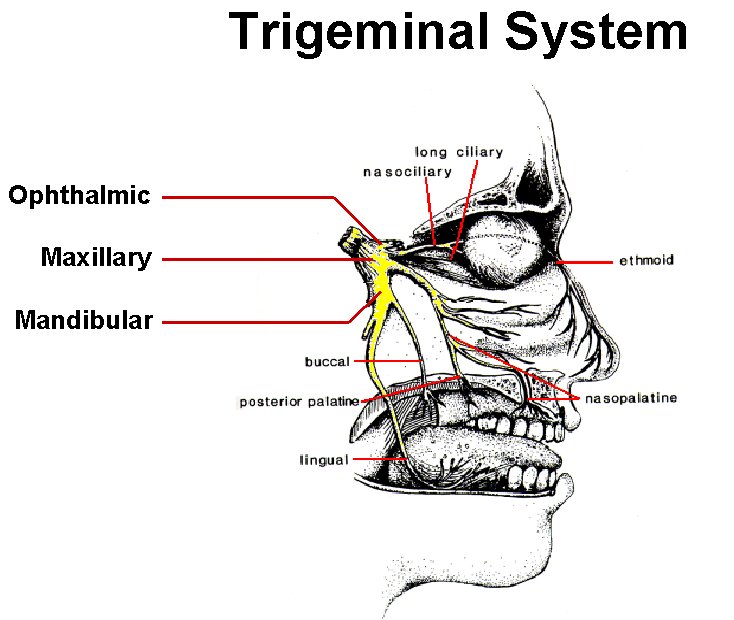
Research My research interest is in the chemical senses taste, smell, and chemesthesis. My current focus is on the receptors responsible for the detection of chemesthetic stimuli. Chemesthesis is the sense of irritation caused by chemicals and mediated by the somatosensory system. Chemesthesis is linked to the trigeminal nerve, which innervates the eye, nose, and mouth. Examples of chemesthesis include the stinging of ammonia and the burning of horseradish and chili peppers. Recently, we have begun examining Transient Receptor Potential (TRP) channels for their ability to detect irritants. For example, TRPV1 is activated by capsaicin (found in chili peppers) and TRPA1 is activated by allyl isothiocyanate (found in wasabi). To examine the role of TRP channels in the detection of chemesthetic irritants, we use behavioral, physiological and genetic techniques on organisms ranging from rats and mice to fruit flies. |
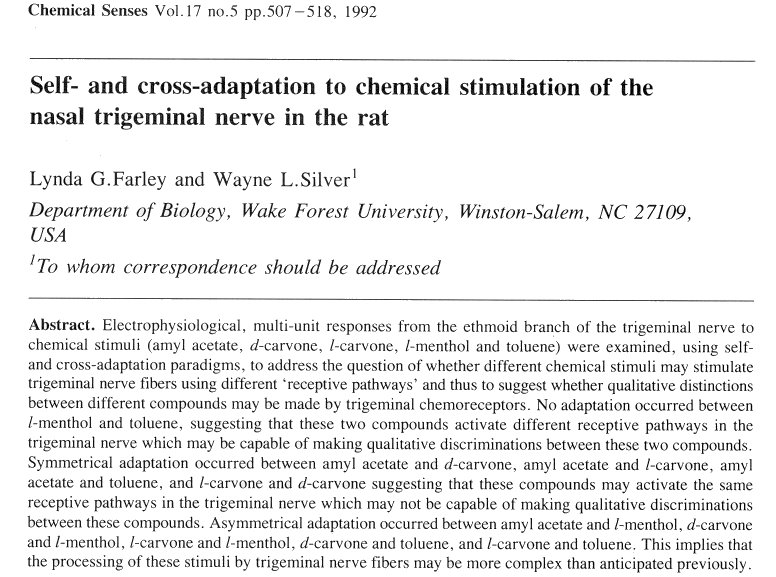
Selected Publications (Graduate Students in Bold) Richards, P.M., Johnson, E.C. and Silver, W.L. (2010) Four irritating odorants target the trigeminal chemoreceptor TRPA1. Chemosensory Perception 3:190-199. click for abstract Tizzano, M., Gulbransen, B.D., Vandenbeuch, A., Clapp, T.R., Herman, J.P., Sibhatu, H.M., Churchill, M.E.A., Silver, W.L., Kinnamon, S.C., and Finger, T.E. (2010) Nasal chemosensory cells use bitter taste signaling to detect irritants and bacterial signals. Proc Natl Acad Sci USA 107:3210-3215. click for abstract Silver, W.L. and Finger, T.E. (2009) Anatomical and Electrophysiological Basis of Peripheral Nasal Trigeminal Chemoreception. Ann. N.Y. Acad. Sci. 1170:202-205. click for abstract Gulbransen, B., Silver, W., and Finger, T. (2008) Solitary chemoreceptor cell survival is independent of intact trigeminal innervation. J. Comp. Neurol 508:62-71. click for abstract Silver W.L. Clapp T.R., Stone L.M., and Kinnamon, S.C. (2006) TRPV1 Receptors and Nasal Trigeminal Chemesthesis. Chem. Senses 31:807-812. click for abstract Finger T.E., Bottger B., Hansen A., Anderson K.T., Alimohammadi H., and Silver W.L. (2003) Solitary chemoreceptor cells in the nasal cavity serve as sentinels of respiration. Proc Natl Acad Sci U S A. 100:8981-6. click for abstract Schaefer, M.L., Bottger, B., Silver, W.L., and Finger, T.E. (2002) Trigeminal collaterals in the nasal epithelium and olfactory bulb: A potential route for direct modulation of olfactory information by trigeminal stimuli. J. Comp. Neurol. 444: 221-226.click for abstract Finger, T.E., Silver, W.L. and Restrepo, D. (editors) (2000) Neurobiology of Taste and Smell 2nd Edition . Wiley-Liss, Inc. 479 pp. click here for information Bryant, B. and Silver, W.L. (2000) Chemesthesis: The common chemical sense. In T.E. Finger, W.L. Silver, and D. Restrepo. (editors) Neurobiology of Taste and Smell 2nd Edition . Wiley-Liss, Inc. 479 pp. 73-100. Silver, W.L. and Browne, C.L.. (2000) Integration of laboratory exercises in development and neurobiology courses using the Xenopus oocyte expression system. J. Industrial Microbiol. Biotech. 24:353-358. click for abstract Alimohammadi, H. and Silver, W.L. (2000) Evidence for nicotinic acetylcholine receptors on nasal trigeminal nerve endings of the rat. Chem. Senses 1:61-66. click for abstract Major, D.A. and Silver, W.L. (1999) Odorants presented to the rat nasal cavity increase cortical blood flow. Chem. Senses 24:665-669. click for abstract Walker, J.C., Kendal-Reed, M., Keiger, C.J., Bencherif, M. and Silver, W.L. (1996) Olfactory and trigeminal responses to nicotine. Drug Dev. Res. 38: 160-168. click for abstract Farley, L.G. and Silver, W.L. (1992) Self- and Cross-adaptation to chemical stimulation of the nasal trigeminal nerve in the rat. Chem. Senses 17: 507-518. click for abstract Silver, W.L., Farley, L.G. and Finger, T.E. (1991) The effects of neonatal capsaicin administration on trigeminal nerve chemoreceptors in the rat nasal cavity. Brain Res. 212-216. click for abstract |