Rick Matthews' Research
Most of my career my research focused on the properties defects in insulating materials, first as an experimentalist and later carrying out ab initio modeling via density functional theory.
In 2007, I was asked to move to university administration full time for a few years (which turned out to be seven years), first as Associate Provost and later as Chief Information Officer. In 2014, I was return to the Department of Physics, but accepted the position of Director of Academic and Instructional Technology, including leading the Instructional Technology Group.
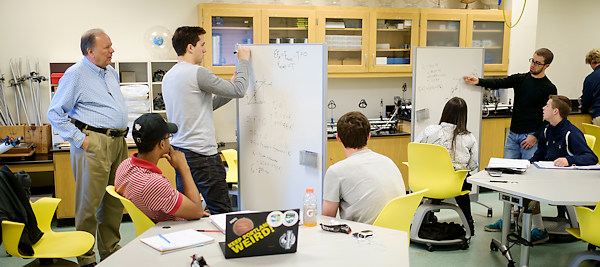
Since then, my scholarship has focused on physics education research, which nicely complements my work both as a member of the faculty of the Department of Physics and as Director of Academic and Instructional Technology. I see the power of technology to enhance student learning, and I am eager to discover the most effective methods for exploiting this power. Of particular interest are the effectiveness of "flipping" classes and exploration of the activites that most effectively enhance cognitive skills and scientific reasoning. Here is a preprint of an upcoming article on my approach to flipping General Physics and the outcomes we have observed.
[an error occurred while processing this directive]